












Description
Japanese 75mm Type 90 Long-Pointed HE Antiaircraft Round with Type 89 Powder Time Fuze and Nagoya Army Arsenal Case
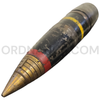
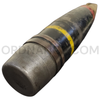
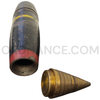
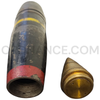
This inert Japanese Army Type 90 75mm high-explosive antiaircraft round combines a July 1943-marked projectile and Type 89 powder time fuze with a Nagoya Arsenal brass case dated July 1941. Offered with its fitted Osaka Arsenal primer, the round represents the timed airburst ammunition used by the Type 88 75mm antiaircraft gun during World War II. Its separately dated components provide a useful example for collectors studying Japanese ammunition production and wartime air defense.
Antiaircraft Purpose and Development
The Type 90 designation corresponds to the 1930 model year. Designed for antiaircraft fire, the service projectile burst during flight and scattered fragments near an aircraft, allowing a nearby explosion to cause damage without a direct hit. This ammunition supported the defense of troops, airfields, and important installations. The documented TNT-filled service projectile weighed approximately 6.5 kilograms, or 14.4 pounds; this is a historical specification rather than the weight of the inert item offered here.
Type 89 Powder Time Fuze
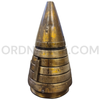
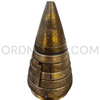
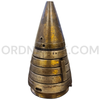
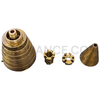
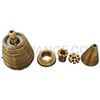
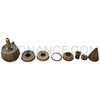
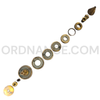
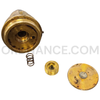
The Type 89 fuze, whose designation corresponds to 1929, controlled the interval between firing and the projectile’s burst. Its powder-burning timing system had a documented range extending to 30 seconds. This timed action was central to the round’s antiaircraft role, allowing the projectile to burst near the anticipated position of an aircraft. The historical service arrangement also employed a separate auxiliary detonating fuze beneath the time fuze. That documented arrangement does not establish the presence of an auxiliary fuze in this display round.
Brass Case and Ammunition Application
The included brass case is the Type 88’s long 75×497R antiaircraft ammunition family. In service, this case held the propelling charge and carried the primer, forming fixed ammunition that was loaded into the gun as one unit. The case is an important part of identifying the complete round: Japanese Army weapons could share a projectile design while requiring different cases and propelling charges. The Type 90 HE-AA projectile is also documented for the Type 11th-Year antiaircraft gun and the Type 88 version listed as “special” in U.S. references, but those projectile applications alone do not establish interchangeability of complete rounds.
Nagoya Case and Osaka Primer Markings
The case headstamp combines 昭, the stacked numerals 十六, and the numeral 7, identifying the seventh month of Shōwa 16, or July 1941. Its circular arsenal emblem identifies Nagoya Army Arsenal. The fitted primer carries 昭十四 and 12, indicating December 1939, together with the Osaka abbreviation 阪 and crossed-cannon emblem. A separate F stamp appears on the case.
Projectile and Fuze Marking Meanings
The fuze marking 昭十八 7 indicates July 1943, while its crossed-cannon emblem and 阪 identify Osaka Army Arsenal. The projectile’s date stamps also indicate July 1943. These component production dates are separate from the Type 90 and Type 89 model years. The black projectile body with red and yellow bands reflects Japanese Army HE identification. Under the simplified wartime marking system, red indicated that a service projectile had been explosive-filled, while yellow identified a high-grade steel HE projectile. These colors describe the historical ammunition classification.
Type 88 Gun Development
Introduced in 1928, the Type 88 developed from the earlier Type 11th-Year 75mm antiaircraft gun of 1922. It became the standard medium antiaircraft gun with which Japanese Army field units entered World War II. The gun’s documented muzzle velocity was approximately 720 meters per second, or 2,360 feet per second. Its role extended beyond air defense to coastal defense and engagement of ground targets, with different ammunition serving those purposes. The Type 90 HE-AA projectile and Type 89 time fuze represented its dedicated timed-airburst combination.
Wartime Air Defense
Type 88 guns served during Japan’s campaigns in China and across the Pacific. Examples fought around Buna, Cape Endairdere, and Sanananda in New Guinea during November and December 1942, where the gun system supported airfield defense and other defensive roles. As Allied air attacks intensified, Type 88 batteries also protected the Japanese home islands. Six guns were installed at Mount Ōzora near Kure in 1944 to defend the naval base against air raids. By that stage, B-29 bombers could often operate above the gun’s effective reach, exposing the limits of this interwar air-defense system.
Condition
Offered as an inert round comprising the Type 90 HE antiaircraft projectile, Type 89 powder time fuze, and brass cartridge case with fitted primer. All ordnance is inert. Please check the pictures for the general condition of the item.
Ideal For
This round supports focused collections and educational exhibits covering:
- Japanese Army antiaircraft ammunition and Type 88 gun service.
- Nagoya and Osaka Arsenal production markings.
- Development of powder time fuzes and airburst ammunition.
- Pacific War and Japanese home-island air defense.
Approx length 16.6", Approx width 3.25", Approx height 3.25", Approx weight 16.5lbs.
Pictures are stock images of our inventory. Unless otherwise noted, you will not be receiving the exact item shown in the pictures. The pictures are representative of the item’s general condition. The item you receive might be slightly better, or worse, condition than was shown in the pictures.
Please visit our page about order lead times here: Order Lead Times.