




Description
Fired 75mm Armor-Piercing Projectile
Item Overview
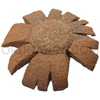
This inert 75mm armor-piercing projectile is a dramatic example of a fired projectile after a severe impact. Its original profile has been transformed into a broad, flower-like pattern, creating a striking display of the forces involved when an armor-piercing projectile meets a hard target. This listing includes the projectile remnant only; no cartridge case, primer, propellant, or other ammunition components are included.
Identification and Features
The item has been identified as a fired 75mm armor-piercing projectile. Its exact model, manufacturer, date, country of origin, and original weapon application cannot be confirmed because no readable identification markings remain visible. The surviving body and driving band provide clear physical evidence of its former use as a gun-fired projectile.
- Caliber: 75mm
- Projectile type: Armor-piercing
- Status: Inert and previously fired
- Configuration: Impact-deformed projectile remnant
- Construction: Ferrous projectile body with a surviving metal driving band
- Included components: Projectile remnant only
- Exact model: Not verified from the surviving markings or form
Function and Design
Armor-piercing projectiles were designed to strike armored plate with a concentrated combination of mass, hardness, and velocity. The driving band sealed propellant gases behind the projectile while engaging the gun barrel’s rifling and giving the projectile stabilizing spin. Depending on the country, period, and weapon, 75mm armor-piercing ammunition could use solid-shot, capped, ballistic-capped, tracer, or bursting-charge designs. The original nose and most of the body are no longer intact on this example, so a specific construction type cannot be confirmed.
Historical Background
The 75mm caliber became one of the most important military gun sizes of the early and mid-20th century. It first gained wide recognition in rapid-firing field artillery and was later adapted to tank guns, antitank guns, assault guns, and limited aircraft installations. During World War II, 75mm guns served in nearly every major theater and were used against armored vehicles, fortifications, gun positions, and other battlefield targets. As armor became thicker, projectile designs developed stronger bodies, protective caps, improved ballistic shapes, and higher operating velocities.
Weapons System History and Use
Numerous nations produced 75mm weapons, and their cartridges and projectiles were not always interchangeable. Representative American World War II systems included the 75mm Guns M2 and M3 used with the M3 medium tank and M4 Sherman family, along with the compact M6 gun used in the M24 Chaffee light tank. American ammunition included solid armor-piercing shot and more complex capped projectile designs. Other countries fielded their own 75mm tank, field, and antitank guns with different projectiles and cartridge cases. These examples provide historical context only and do not establish the original weapon that fired this particular projectile.
Condition
This projectile has been fired and is extensively deformed from impact. The photographs show heavy overall oxidation, broad fracture surfaces, material loss, and numerous sections of the body spread outward around the remaining core. Its surviving driving band and unusual impact shape remain visible. Please check the pictures for the general condition of the item.
Ideal For
This fired projectile offers an unusual view of armor-piercing ammunition after impact. Its highly deformed form makes it an interesting educational object, conversation piece, or addition to a collection focused on artillery, armored warfare, military technology, or projectile design.
- Military ordnance and artillery collections
- Armored-warfare displays
- Museum or educational exhibits
- Projectile and ballistics study collections
- Historic industrial décor
Approx length 8", Approx width 8", Approx height 5", Approx weight 13.9lbs.
Pictures are stock images of our inventory. Unless otherwise noted, you will not be receiving the exact item shown in the pictures. The pictures are representative of the item’s general condition. The item you receive might be slightly better, or worse, condition than was shown in the pictures.
Please visit our page about order lead times here: Order Lead Times.