








Description
German 75mm Igr.38 Hl/A HEAT Round with A.Z.38 Fuze
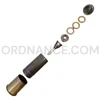
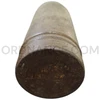
This German 75mm infantry-gun round combines an Igr.38 Hl/A hollow-charge projectile, an A.Z.38 nose fuze marked 1943, and a short brass cartridge case. Associated with the 7.5 cm le.I.G.18 light infantry gun, it represents the anti-tank ammunition developed for German close-support artillery during World War II. Its separate nose section and retained internal components give collectors and museums useful details for interpreting the projectile’s construction.
Identification and Features
- Projectile: Steel body with a driving band, screw-on nose section, and retained internal insert, metal disc, and spacer rings.
- Nose fuze: Marked “AZ38” and “ccw 43 61.” The “43” indicates 1943 manufacture of the fuze.
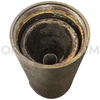
- Brass case: Headstamped “6341,” with additional “P,” “G,” and “5” markings and an eagle over “WaA107” military acceptance mark.
- Primer: Marked “C/12 nA St,” with “41” and “15.” The “41” indicates 1941 primer manufacture.
Hollow-Charge Development and Role
The Igr.38 Hl/A followed the earlier Igr.38 hollow-charge projectile as part of Germany’s wartime development of anti-tank ammunition for infantry support guns. Hollow-charge ammunition, now commonly called high-explosive anti-tank or HEAT, gave the low-velocity infantry gun a means of engaging armored vehicles. The Hl/A used revised internal construction within the compact infantry-gun projectile. U.S. ordnance references list its historical loaded and fuzed weight as approximately 6¾ pounds and identify it as a projectile without a tracer. Its documented applications included both the standard le.I.G.18 and the le.Geb.I.G.18 mountain infantry gun.
Fuze, Case, and Primer
The A.Z.38 was a mechanical impact fuze used with German hollow-charge projectiles. Its aluminum-bodied design was also produced in a steel-bodied version designated A.Z.38 St. The brass 6341 case belonged to the separate-loading ammunition system of the light infantry gun, alongside the steel 6341 St case. The C/12 nA percussion primer family served widely in German artillery ammunition, with “St” identifying the steel version.
7.5 cm le.I.G.18 History and Service
Rheinmetall-Borsig developed the le.I.G.18 in 1927 to provide infantry with a light artillery weapon for close support. German infantry regiments used it during World War II against positions that required more firepower than small arms could provide. Its short barrel and wide elevation range suited both direct fire and fire over intervening cover. Standard guns used a box-trail carriage, with wheel arrangements for horse or motor transport. A mountain version, the le.Geb.I.G.18, entered service in 1937 with a split-trail carriage and construction suited to transport in separate loads. Both versions used high-explosive and hollow-charge ammunition, allowing the same gun family to support infantry and provide a limited anti-tank capability.
Condition
All ordnance is inert. Please check the pictures for the general condition of the item.
Ideal For
This round suits collections and exhibits focused on German infantry artillery and wartime ammunition development.
- World War II German artillery ammunition collections.
- Displays associated with the le.I.G.18 or mountain infantry artillery.
- Museum interpretation of hollow-charge projectile development.
- Study of German fuze, primer, and cartridge-case markings.
Approx length 11.5", Approx width 3.25", Approx height 3.25", Approx weight 6.8lbs.
Pictures are stock images of our inventory. Unless otherwise noted, you will not be receiving the exact item shown in the pictures. The pictures are representative of the item’s general condition. The item you receive might be slightly better, or worse, condition than was shown in the pictures.
Please visit our page about order lead times here: Order Lead Times.