




Description
German 75mm PaK 40 Armor-Piercing Round
This inert German 75x714mm PaK 40 round combines a marked steel case, a dark-finished armor-piercing projectile with surviving red stencils, and a 1943-marked base fuze. The readable markings and visible components make it a useful display and reference piece for collectors of German antitank ammunition and Marder tank destroyers. Very scarce round and the only one we have available, so you will be receiving the exact round shown in the photos!
Identification & Features
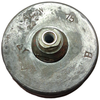
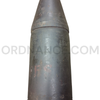
The case head carries 6340 St, the PaK 40 designation, the number 119, and an eagle acceptance mark. A percussion primer remains installed in the head. The projectile retains red FES and 3 B stencils, with additional worn lettering. Its base bears readable 75 and B stamps. The capped nose, dark finish, FES marking, and base-fuze arrangement are consistent with the 7.5 cm Panzergranate 39 FES projectile.
Pzgr. 39 FES Projectile and Base Fuze
The Pzgr. 39 was an armor-piercing capped projectile with a ballistic cap, commonly abbreviated APCBC. Its armor-piercing body and penetrative cap were covered by a streamlined outer cap that reduced drag. Historical service examples carried a small bursting charge and a base-mounted tracer, combining armor penetration with an explosive effect after penetration and a visible flight trace. The loaded and fuzed projectile weighed approximately 6.8 kg, or 15 lb. The FES marking identifies a sintered-iron driving band, reflecting the wartime move toward iron bands in place of copper-covered iron bands.
Steel Case and Percussion Primer
The 6340 St designation describes the steel case used for this PaK 40 ammunition. The projectile and case formed a fixed round for loading together. Although Pzgr. 39 projectiles also appeared in KwK 40 and StuK 40 ammunition, those guns used a different, shorter case. This 75x714mm round belongs to the PaK 40 ammunition family.
PaK 40 Development and Wartime Role
Development of a heavier German antitank gun began in 1939, with Rheinmetall-Borsig producing the design adopted as the 7.5 cm PaK 40. It followed the general layout of the smaller 5 cm PaK 38 but used a larger gun and a heavier steel carriage. Initial deliveries began late in 1941, followed by wider issue in 1942. As heavier tank armor reduced the usefulness of the 3.7 cm PaK 35/36 and challenged the 5 cm PaK 38, the PaK 40 became Germany’s standard antitank gun. It retained a low silhouette, split trails, a protective shield, and a muzzle brake, and remained in German service through the end of World War II.
Marder Tank Destroyer and Armored Vehicle Applications
Beyond the towed gun, PaK 40 variants armed Marder II and Marder III tank destroyers, placing the weapon on tracked chassis for mobile antitank support. These vehicles used chassis derived from the Panzer II and Czech-built Panzer 38(t), respectively. The Marder III Ausf. H carried the 7.5 cm PaK 40/3. Their open fighting compartments accommodated a powerful gun on relatively light vehicles, though crew protection remained limited. The PaK 40 also armed the eight-wheeled Sd.Kfz. 234/4, extending its antitank role to an armored-car chassis.
Condition
The case shows extensive surface discoloration, scattered corrosion, scratches, and pronounced pitting around the head. The projectile retains dark finish and portions of its red stenciling, with finish wear, oxidation, and surface marks. The base fuze shows localized corrosion and tool marks around its flats. The photographs show the projectile base and the fuze separately for inspection. All ordnance is inert. Please check the pictures for the general condition of the item.
Ideal For
The marked case and visible projectile details support both display and close study of German wartime ammunition.
- PaK 40 antitank gun collections and museum exhibits.
- Marder II and Marder III vehicle restoration displays.
- Reference collections studying German case stamps, projectile markings, and base fuzes.
Approx length 38.5", Approx width 4", Approx height 4", Approx weight 21lbs.
Pictures are stock images of our inventory. Unless otherwise noted, you will not be receiving the exact item shown in the pictures. The pictures are representative of the item’s general condition. The item you receive might be slightly better, or worse, condition than was shown in the pictures.
Please visit our page about order lead times here: Order Lead Times.