










Description
U.S. Navy 5-Inch/38-Caliber Boresight Mark 38 Mod 1 Optical Alignment Kit
Item Overview
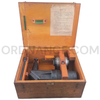
This U.S. Navy Boresight Mark 38 Mod 1 is a precision optical alignment kit made for the 5-inch/38-caliber Mark 12 naval gun. Its two principal assemblies fitted into the muzzle and open breech, turning the gun barrel into a large telescope. This gave shipboard ordnance crews a direct view along the true axis of the bore. They could then check and adjust the gun sights and fire-control equipment so that each system pointed along the same reference line.
Identification and Features
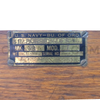
The identification plate names the equipment as a Boresight Mark 38 Mod 1 and identifies Westinghouse Electric & Manufacturing Co. at the Naval Ordnance Plant in Center Line, Michigan. The serial number reads 623. U.S. Navy O.P. 1449 illustrates the same muzzle and breech assemblies and describes their optical construction, installation, adjustment, and storage.
- Designation: Boresight Mark 38 Mod 1
- Gun caliber: 5-inch/38
- Parent weapon: 5-inch/38 Mark 12 naval gun
- Manufacturer: Westinghouse Electric & Manufacturing Co.
- Facility: Naval Ordnance Plant, Center Line, Michigan
- Serial number: Appears to be 623
- Magnification: 8.5×
- Field of view: 1° 32′
- Exit pupil: 4.20 mm
- Reference manual: U.S. Navy O.P. 1449
Historical Background
Westinghouse assumed operation of the Naval Ordnance Plant at Center Line in October 1943. The plate still uses the Westinghouse Electric & Manufacturing Co. name, which changed in 1945. These details place the likely manufacturing period between late 1943 and 1945, although an exact production date is not marked. The Navy continued to document the boresight after World War II, including detailed instructions in O.P. 1449 and a general-arrangement drawing in the twin-mount manual O.P. 805.
How the Boresight Worked
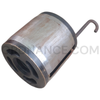
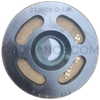
The round objective assembly was inserted into the muzzle and centered by expanding sleeve segments. The larger breech assembly entered the open gun chamber and was centered by tapered bearing rings. This assembly contained the eyepiece, reticle, and most of the remaining optical system. With both sections installed, the gun barrel became the body of the telescope and its optical axis matched the bore axis. The crew viewed a distant reference point through the eyepiece and compared that line with the gun sight and fire-control alignment. The included instructions state that alignment could be obtained within one-half minute of arc.
Included Equipment
This example appears substantially complete with the two principal optical assemblies, fitted carrying chest, and original instruction material. The muzzle objective and breech eyepiece assemblies are the main parts needed to establish the optical line through the gun barrel. Navy documentation also shows small accessories such as filters and an extracting tool with a complete outfit. The available photographs do not confirm the presence of every small cap, filter, tool, or spare originally packed in the chest.
End-Item Application
The Boresight Mark 38 Mod 1 was made for the Navy’s 5-inch/38 Mark 12 gun and was not restricted to a single gun-mount model. Navy publications document it with twin 5-inch/38 Mounts Mark 28, Mark 32, and Mark 38. The “Mark 38 Mod 1” designation belongs to the boresight itself; it does not mean the instrument was used only with Mount Mark 38. It is also unrelated to the much later 25 mm Mark 38 weapon system.
5-Inch/38 Mark 12 Weapon-System Background
The 5-inch/38 Mark 12 entered U.S. Navy service during the 1930s and became one of the Navy’s most widely used dual-purpose guns. It could engage surface ships and shore targets while also serving as a heavy antiaircraft weapon. The gun appeared aboard battleships, aircraft carriers, cruisers, destroyers, and other naval vessels in single and twin mounts. High elevation, power-assisted handling, and connection to director-controlled fire-control systems allowed the weapon to serve in both surface and air defense roles. The 5-inch/38 remained in American service after World War II and continued to see use during later conflicts and training operations.
History of Use
Shipboard ordnance and fire-control personnel used boresighting equipment to keep a gun’s sights aligned with the direction in which its barrel actually pointed. The Mark 38 Mod 1 provided a fixed optical reference through the bore after maintenance, adjustment, or other work that could affect alignment. Crews could compare this reference with the pointer’s and trainer’s sighting lines and with the mount’s fire-control equipment. Correct alignment helped the mount follow director commands and place fire according to the calculated solution. The boresight was a maintenance and calibration instrument and was removed before the gun returned to firing service.
Condition
This set appears substantially complete with its muzzle assembly, breech assembly, fitted storage chest, and original instructions. The serial number is 623. Every small accessory cannot be confirmed from the available photographs, so buyers should use the pictured contents as the guide to what is included. The internal condition, clarity, and alignment of the optical elements are unknown. Exterior condition and finish are represented by the inventory photographs.
Ideal For
This identified optical kit has direct connections to U.S. Navy shipboard ordnance, fire-control maintenance, and the long-serving 5-inch/38 Mark 12 gun. Its documented configuration, wartime Westinghouse plate, original chest, and instructions make it suitable for a focused naval-artillery display or technical collection.
- U.S. Navy ordnance collections
- 5-inch/38 gun and mount displays
- Naval fire-control exhibits
- World War II equipment collections
- Museum and restoration research
- Westinghouse military-production displays
Approx length 20", Approx width 16", Approx height 8.75", Approx weight 45 lbs.
Pictures are stock images of our inventory. Unless otherwise noted, you will not be receiving the exact item shown in the pictures. The pictures are representative of the item’s general condition. The item you receive might be slightly better, or worse, condition than was shown in the pictures.
Please visit our page about order lead times here: Order Lead Times.