




Description
U.S. Navy 5-Inch/38 Mk 35 Mod 5 AA Common Projectile with Mk 71 Mod 11 Fuze
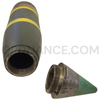
This U.S. Navy 5-inch/38-caliber Mk 35 Mod 5 AA Common projectile is offered with Mk 71 Mod 11 proximity fuze as an inert display combination. The projectile carries its designation and lot markings on the driving band, while the fuze bears an EK manufacturer code associated with Eastman Kodak.
Identification & Features
The projectile’s driving band is stamped “G.C.C.B 5IN-A.A.COM MK35 MOD 5 LOT 000 37.” The fuze is stamped “MK 71 MOD 11 LOT 03 EK1175 R 10001 1310844” and carries a separate “C&S” stamp.
- 5IN-A.A.COM: Identifies a 5-inch antiaircraft-common projectile.
- MK35 MOD 5: Mark 35, modification 5, the projectile designation.
- LOT 000: The projectile lot marking as supplied, including its leading zeros.
- 37: Consistent with a 1937 specification-year marking. Period Navy instructions describe this driving-band field as the year of specification
- MK 71 MOD 11: Mark 71, modification 11, a proximity or VT fuze.
- LOT 03: The fuze lot marking.
- EK: Eastman Kodak Company of Rochester, New York, listed in military manufacturer records under its Apparatus and Optical Division.
- 1310844: A cataloged reference number associated with the Mk 71 Mod 11 fuze.
- Included components: Projectile and Mk 71 Mod 11 fuze.
AA Common Projectile Development
The Mk 35 belonged to the Navy’s antiaircraft-common projectile family, intended for antiaircraft fire and bombardment. Navy ordnance references list Mk 35 modifications 1 through 12, including this Mod 5, for the 5-inch/38 gun. The family accommodated several generations of time, impact, and proximity fuzes as naval ammunition evolved. The related Mk 47 projectile was developed with additional body weight to compensate for newer, lighter fuzes while maintaining the standard ballistic weight. Tracers provided a visible indication of projectile flight in tracer-equipped configurations.
Mk 71 Mod 11 Proximity Fuze
The Mk 71 Mod 11 belongs to the Navy’s electronic proximity-fuze family. Its service role was to initiate a burst near a target without requiring a direct hit. Military catalog records associate this fuze with the 5-inch/38 Mk 35 projectile family. Those listed proximity-fuzed service configurations omitted the tracer; the tracer-equipped example offered here is presented as an inert display combination.
The 5-Inch/38 Gun in Naval Service
The dual-purpose 5-inch/38 gun entered service with the Farragut-class destroyers completed in 1934–1935. It gave the new destroyers a gun suited to both aircraft defense and surface engagements, and it continued into subsequent destroyer classes. During World War II, these guns also provided close naval gunfire support against shore positions. At Normandy in June 1944, American destroyers used their 5-inch/38 guns to engage German defenses and support troops moving inland. This range of duties explains the demand for ammunition that could serve both antiaircraft and bombardment roles.
Condition
Includes the described projectile and Mk 71 Mod 11 fuze as an inert display combination. All ordnance is inert. Please check the pictures for the general condition of the item.
Ideal For
The projectile and fuze markings provide specific points of interest for naval ammunition collectors and historical displays.
- U.S. Navy 5-inch/38 gun and ammunition collections.
- Displays covering antiaircraft-common projectile development.
- Eastman Kodak military-production and proximity-fuze collections.
- Museum exhibits on destroyer armament and naval gunfire support.
Approx length 21", Approx width 5", Approx height 5", Approx weight 43.7lbs.
Pictures are stock images of our inventory. Unless otherwise noted, you will not be receiving the exact item shown in the pictures. The pictures are representative of the item’s general condition. The item you receive might be slightly better, or worse, condition than was shown in the pictures.
Please visit our page about order lead times here: Order Lead Times.