




Description
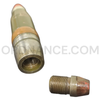
WWII 40mm Mark 2 HE-T Round with M25B1 Steel Case and HE-I-T Fuze
This WWII 40mm Mark 2 round pairs a projectile dated 1943 with a RARE M25B1 steel case also dated 1943. The round is offered inert for collection and display. Original lacquer and paint markings on the steel case, and original paint on the projectile!
Identification and Features
The MKII T driving-band stamp identifies the Mark II projectile with tracer provision. The 43 on the case dates that component to 1943. Each component carries its own lot marking.
- Projectile driving-band stamp: LOT E.S.4 1943 -40MM-MKII T.
- Case headstamp: 40 MM M25B1 ECBC LOT 34 43.
Mark 2 HE-T Projectile History and Function
The Mark 2 belonged to the high-explosive tracer ammunition family adapted from British Bofors rounds for American production. In service, a nose impact fuze burst the shell to produce blast and fragments, while a separate base tracer helped gunners follow the projectile's flight. Self-destroying service versions also used the tracer system to break up shells that missed their targets. Early American production faced difficulties with the complex British fuze. U.S. development introduced alternative designs, including the Navy's Mark 27 point-detonating fuze, which the Army also used.
M25B1 Steel Case and Wartime Production
The M25B1 was an American steel case developed as an alternative to the brass M25. In 1944, the Army listed it as substitute standard and described it as closely following the M25, with changes around the head to suit steel construction. Its development was part of the Ordnance Department's effort to conserve copper as ammunition requirements rose during WWII. Steel cases had to work in the same guns as their brass counterparts, and manufacturers had to overcome problems with forming the cases and protecting them from corrosion. The M25B1 was among the steel artillery cases that reached quantity production.
Bofors L/60 Origins and American Adoption
The Bofors 40mm gun grew from a 1928 Swedish naval requirement for a new antiaircraft weapon. Development during the early 1930s produced an automatic gun suited to engaging low-flying aircraft. Britain adopted the weapon before the United States and supplied an example and drawings that helped start the American program. The U.S. Army adopted the air-cooled version as the 40mm Automatic Gun M1 in April 1941, intending it to replace the 37mm antiaircraft gun once enough Bofors guns could be produced. The 40mm fired a heavier projectile at higher velocity than the earlier American 37mm weapon. Chrysler prepared the gun for American manufacture, while Firestone worked on the carriage. Both programs required converting foreign drawings and revising parts for quantity production.
Documented Application and WWII Use
Mark 2 HE-T ammunition was used in the 40mm Automatic Gun M1. For ground service, the gun commonly used a four-wheeled M2-series carriage and fed from four-round clips. It gave batteries rapid fire against dive bombers and other low-flying aircraft, supplementing heavier antiaircraft guns. Both Army units and Marine defense battalions used the M1 during WWII. In the Solomons, the 9th Defense Battalion deployed Bofors guns on Rendova and New Georgia, providing protection for the Zanana beachhead and supporting the advance toward Munda airfield. Related L/60 guns served in naval mountings aboard Allied warships.
Development into Mobile Antiaircraft Mounts
Combat experience in North Africa showed the need for antiaircraft guns that could keep pace with armored forces. American trials of mobile mountings led to the M19 Gun Motor Carriage, designated in 1944 with twin 40mm guns on an M24 light-tank chassis. The postwar M42 Duster continued this approach using the M41 light-tank chassis and twin Bofors guns. The M42 entered Army service in 1953 and later saw combat in Vietnam, where its guns also provided ground fire support.
Condition
The projectile's base tracer housing is present and empty. All ordnance is inert. Please check the pictures for the general condition of the item.
Ideal For
Suitable for collectors comparing wartime Bofors projectiles and the American use of steel cartridge cases.
- WWII 40mm Bofors ammunition collections
- M1 antiaircraft gun and L/60 restoration displays
- Research into projectile lots, headstamps, and steel cases
- Museum exhibits on American wartime production and air defense
Approx length 17.5", Approx width 2.5", Approx height 2.5", Approx weight 3.3lbs.
Please visit our page about order lead times here: Order Lead Times.