



Description
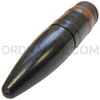
U.S. 40mm M81A1 Armor-Piercing Tracer Projectile
This U.S. 40mm M81A1 Armor-Piercing Tracer projectile represents the armor-defeating ammunition developed for American Bofors 40mm guns. Offered as an inert projectile, it connects a World War II ammunition design with Army antiaircraft guns, Navy shipboard mounts, and the mobile gun systems that continued serving during the Cold War. Its documented applications make it a useful collecting and research piece for those interested in American automatic cannon ammunition.
Armor-Piercing Purpose and Tracer Function
The M81A1 was intended for armored and other protected targets. Its hardened, one-piece steel body penetrated through impact and carried no high-explosive bursting charge or impact fuze. A thin steel windshield reduced air resistance over the projectile’s blunt penetrating nose. In service ammunition, a red tracer in the base burned for approximately 12 seconds, allowing crews to observe the projectile’s flight. Historical ammunition tables list a projectile weight of approximately 1.96 pounds, including its tracer, while Army data sheets give a muzzle velocity of 2,870 feet per second for the complete AP-T loading.
Development from the M81
The M81A1 followed the earlier M81 armor-piercing tracer projectile. The principal documented change concerned the windshield attachment: the M81 used an adapter, while the M81A1 secured the windshield directly to the projectile by crimping. Both retained the same basic role as hardened steel shot with a visible tracer. Army ammunition manuals described the M81A1 during World War II, including the June 1944 edition of TM 9-1901. Both M81 and M81A1 remained listed in later Army ammunition references, including the 1994 ammunition data sheets. The M81A1 therefore belongs to a design family documented across wartime and postwar American service.
The Bofors Gun in U.S. Army Service
Army ammunition references list the M81A1 for the M1 and M2 series of 40mm guns, along with the Navy Mk 1. These weapons belonged to the Swedish-designed Bofors L/60 family. The U.S. Army adopted the air-cooled Bofors as the 40mm Automatic Gun M1 in April 1941, intending it to supersede the 37mm antiaircraft gun as production became available. American manufacture required adapting the Swedish drawings and production methods for large-scale output, with Chrysler playing a major role in Army gun production. The resulting 40mm weapons gave antiaircraft units a rapid-firing cannon supported by several ammunition types. The M81A1 supplied the armor-piercing option within that ammunition range.
Naval Adoption and Shipboard Use
The Navy evaluated a Swedish Bofors gun brought to the United States in 1940, and American shipboard installations followed in 1942. Water-cooled guns in twin and quadruple mounts became an important part of the fleet’s close-range air defenses, filling the gap between lighter automatic weapons and larger antiaircraft guns. The Navy’s 1947 ordnance manual specifically described the M81A1 as an Army design manufactured for naval use to Navy specifications. It distinguished the AP-T version, with its red tracer, from an AP version with the tracer cavity plugged. This documented Navy adoption gives the M81A1 a direct connection to American shipboard ordnance as well as Army equipment.
Mobile Applications: M19 and M42 Duster
The Army also carried the Bofors system on tracked vehicles so that antiaircraft weapons could accompany armored formations. Developed during World War II, the M19 Gun Motor Carriage mounted twin 40mm guns on a chassis derived from the M24 Chaffee light tank. It later served in Korea, where its guns also proved useful for ground support. The M42 Duster entered service in 1953 as its successor, using an M41 Walker Bulldog-derived chassis while retaining twin 40mm armament. Faster jet aircraft reduced the usefulness of this gun system for air defense, but the Duster found an extensive ground-support role in Vietnam. Its duties included convoy escort, point security, and perimeter defense.
Ideal For
The M81A1 supports displays and research that explain the different ammunition roles within the American Bofors system.
- U.S. 40mm and Bofors L/60 ammunition collections.
- Interpretive displays accompanying M1 guns, M19 vehicles, or M42 Duster restorations.
- Museum exhibits covering Army and Navy automatic cannon development.
- Comparative study of armor-piercing, high-explosive, and training projectiles.
Approx length 6", Approx width 1.5", Approx height 1.5", Approx weight 2lbs.
Pictures are stock images of our inventory. Unless otherwise noted, you will not be receiving the exact item shown in the pictures. The pictures are representative of the item’s general condition. The item you receive might be slightly better, or worse, condition than was shown in the pictures.
Please visit our page about order lead times here: Order Lead Times.