








Description
WWI U.S. Army 4.7-Inch Mk II Special-Gas Projectile with Mk III Point-Detonating Fuze
Product Overview
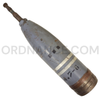
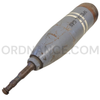
This U.S. Army World War I–era 4.7-inch Mk II special-gas projectile is fitted with a Mark III point-detonating nose fuze. It represents a specialized ammunition type developed for the American M1906 field gun. Its surviving painted identification and stamped production marks connect the object to the wartime system of factories, ammunition inspectors, and military supply organizations that supported the Army’s artillery. Original paint and markings!!
Identification and Markings
The exterior matches the “4.7-inch Common Steel Shell, Mark II (Gas)” in the American Expeditionary Forces’ 1919 marking guide, Publication F 85. Issued in France, the guide contained eighteen plates covering ammunition, fuzes, and containers. Its dedicated 4.7-inch plate documents the following identification system.
- SPECIAL GAS: The period designation for chemical-agent ammunition.
- Two white bands on a gray body: The documented CG, or phosgene, marking scheme. This identifies the filling represented by the paint.
- 4.7-G: Identifies 4.7-inch gun ammunition; G means “gun” and distinguishes it from ammunition for the 4.7-inch howitzer.
- Black squares below the shoulder: Weight-classification marks used to group projectiles by weight.
- M M Co.: Manufacturer’s marking on the projectile body.
- LOT NO 1027-7.: Projectile manufacturing lot marking, transcribed as supplied.
- AB1AV: Additional stamped code recorded on the body.
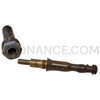
- P.D.F. M III: Identifies the Mark III point-detonating fuze.
- B H / LOT 12: Apparent manufacturer’s marking on the fuze and its separate production lot, number 12.
Function
The historical purpose of this pattern was to provide the field gun with chemical ammunition. Its nose fuze was an impact type, as indicated by the term “point-detonating.” The name “common steel shell” described the projectile family, while the added “Gas” designation identified this version’s intended role.
Product History
When the United States entered World War I in April 1917, chemical warfare was already an established part of the conflict. Building an American supply required shell manufacture, filling facilities, inspection, protective equipment, and trained personnel. Edgewood Arsenal in Maryland became a major center of this effort, with facilities that filled 4.7-inch and other projectiles with CG. The Chemical Warfare Service was established on June 28, 1918, to unite work on gas offense and defense. The Mk II belongs to this wartime expansion. Proving and training work at Lakehurst, New Jersey, supported the broader program.
Documented End-Item Application
The intended weapon was the U.S. 4.7-inch field gun, Model of 1906. Period references list gas shells alongside the gun’s high-explosive and shrapnel ammunition. The M1906 used fixed ammunition, meaning the projectile and cartridge case formed a single cartridge in its service configuration. These different ammunition types gave one gun several assigned roles. The model year belongs to the weapon and should not be read as the manufacture date of its ammunition.
Equipment History
The fitted Mk III belongs to the American point-detonating fuze family documented during World War I. A period fuze chart identifies its French counterpart as the IAL type and lists its use with gas-shell ammunition across several artillery calibers. This reflects the wartime exchange of Allied designs as the United States expanded its ordnance supply. The fuze therefore had a broader service application than this one projectile. Its own maker and lot marks record a separate component history, which is useful when studying an assembled historical example.
Weapon-System Background
The M1906 was an American-designed medium field gun developed before the war, with sixty in service when the United States entered the conflict. It offered greater shell weight and reach than the Army’s light field guns and was intended for tasks that included engaging enemy artillery. Its long-recoil carriage allowed seventy inches of rearward gun movement, checked by hydraulic resistance, with springs returning the gun to position. Wartime manufacture required both arsenal capacity and commercial contractors, with gun tubes and carriages produced through separate programs. The government’s production report records sixty-four complete 4.7-inch units shipped overseas by the Armistice, including forty-eight previously available weapons and sixteen newly produced units.
History of Use
American forces used chemical ammunition on the Western Front, drawing on British and French supplies. Official U.S. histories state that domestically produced American chemical agents and weapons were not used in World War I combat. The M1906’s deployment and the manufacture of U.S. gas shells are therefore separate historical facts.
Postwar History
Following the Armistice of November 11, 1918, unused wartime chemical ammunition became part of the Army’s interwar stockpile. After 1919, most Chemical Warfare Service divisions moved to Edgewood Arsenal. The service became a permanent part of the Regular Army on July 1, 1920, and continued research, training, and the development of defensive measures. The survival of wartime stocks gave the Army an existing supply base as it shaped a permanent chemical-warfare organization.
Condition
All ordnance is inert. Please check the pictures for the general condition of the item. This example shows chipped paint, readable stenciling, and surface oxidation on exposed metal.
Ideal For
Collectors can compare this example with original AEF drawings, while curators can place it within exhibits about America’s wartime industry and the legacy of chemical warfare. It also provides a physical companion to period ordnance manuals and ammunition-marking charts.
- World War I U.S. Army ordnance collections.
- M1906 field-gun ammunition displays.
- Museum exhibits on chemical-warfare and industrial history.
- Reference collections studying shell and fuze markings.
Approx length 21", Approx width 4.7", Approx height 4.7", Approx weight lbs.
Pictures are stock images of our inventory. Unless otherwise noted, you will not be receiving the exact item shown in the pictures. The pictures are representative of the item’s general condition. The item you receive might be slightly better, or worse, condition than was shown in the pictures.
Please visit our page about order lead times here: Order Lead Times.