




Description
4.2-Inch M2A1 ALT CG Inert Mortar Projectile
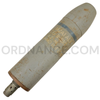
This 4.2-inch M2A1 ALT CG mortar projectile carries an "INERT" stencil and a February 1963 date marking. It has a grey-painted body, a blue band, and white identification lettering. Liquid remains inside the body, along with a green tube running down its center. This Cold War-era example connects the history of U.S. chemical-mortar ammunition with the M2 and M30 heavy-mortar systems. Its dated lot marking and separate tube stamps make it a useful addition to an ordnance collection or ammunition-history display.
Identification and Features
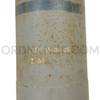
The body stencil records the projectile designation, ammunition lot, and date. The green central tube carries its own set of stamps, recorded here by their positions.
- Caliber: 4.2 inches, approximately 107mm.
- Designation stencil: M2A1 ALT CG INERT 4.2"-M
- Lot and date stencil: AMMO LOT LS-DZ-331 2/63
- Finish: Grey paint with a blue band and white lettering.
- Contents: Liquid fill and a green central tube.
- Tube stamp, top: "WH-1-6".
- Tube stamp, left: "A".
- Tube stamp, right: "H".
- Tube stamp, bottom: "10-53-T-31".
Function and Contents
The M2A1 service projectile was designed to carry a filling inside a hollow body. Its internal layout included space for a central burster assembly associated with the nose fuze. Army drawings also show internal vanes, which were part of the liquid-carrying design. The offered example retains liquid and a green central tube. The retained fill and central tube are key features of this specimen's internal layout.
Markings and Date
"ALT" identifies the alternate version within the M2A1 projectile family. "CG" was the U.S. military code for phosgene, a toxic chemical agent associated with service ammunition of this type. "INERT" is the stated condition marking on this example. The stencil "2/63" reads as February 1963, while "LS-DZ-331" records its ammunition lot. These markings should be kept separate from the tube's identification stamps. The individual letters "A" and "H" on that tube are not treated as proof of a chemical filling, maker, or inspection office.
Product History
The M2A1 developed from the earlier M2 chemical-mortar projectile family. Army ammunition manuals distinguish the models by changes to the mechanism at the projectile's base. The alternate design was also formally documented: a U.S. government publication catalog lists specification MIL-S-13933A, dated May 14, 1956, covering CG loading assemblies for M2, M2 alternate, M2A1, and M2A1 alternate shells. This establishes the alternate CG designation before the date on this specimen. Its 1963 stencil places it within the continued Cold War history of an ammunition family with earlier military roots.
Documented Applications
Army Technical Manual TM 43-0001-28 lists the M2 and M30 4.2-inch mortars as the parent weapons for M2A1 chemical cartridges. These are the documented weapon connections for this projectile family. The model names identify separate items: M2A1 describes the ammunition, while M2 and M30 describe the mortars. For collectors, this connection supports displays comparing wartime chemical-mortar equipment with later infantry heavy-mortar systems.
Equipment History
The American 4.2-inch mortar grew from the British Stokes mortar used during World War I. During the 1920s, the U.S. Chemical Warfare Service developed a rifled version, leading to the M1 mortar's entry into service in 1928. Further work produced the M1A1 and then the stronger wartime M2. Experience in rugged terrain and demands for better performance led to a new design near the end of World War II. Development continued after the war, and the Ordnance Department standardized the M30 in 1951. The M30 carried the same basic caliber into a new generation of heavy-mortar equipment.
Weapon-System Background
The 4.2-inch mortar filled the role of a heavy infantry-support weapon. The M30 used a rifled barrel and fired on a high, arcing path, allowing indirect fire against positions beyond a crew's direct view. Rifling gave compatible projectiles spin for stability in flight. Its ammunition family included high-explosive, smoke, and illumination rounds as well as older chemical types. The mortar could serve in ground positions or tracked mortar carriers. This broad role explains why 4.2-inch ammunition appears in collections of both Chemical Warfare Service equipment and conventional infantry weapons.
History of Use
The 4.2-inch chemical mortar first entered combat during the invasion of Sicily in July 1943. The 2nd and 3rd Chemical Mortar Battalions supported the campaign, firing about 35,000 rounds during the fighting. Their missions included infantry support and smoke screening, and the weapon later served in Europe and the Pacific. Despite the name "chemical mortar," U.S. forces did not use their toxic chemical ammunition in World War II combat. The weapon's wartime reputation came from conventional high-explosive and smoke fire. Chemical ammunition remained part of military stockpiles, testing, and preparedness programs. This inert-marked specimen belongs to that wider history; its date and lot stencil do not establish service with a particular unit.
Condition
The nose fuze is missing. The body retains liquid and the green central tube described above. Please check the pictures for the general condition of the item.
Ideal For
This marked projectile suits collections that document the development of American mortar ammunition. Its dated stencil, alternate designation, and internal tube markings give researchers several details to compare with period records.
- U.S. mortar-ammunition collections.
- M2 and M30 mortar displays.
- Chemical Warfare Service and Chemical Corps exhibits.
- Cold War ordnance-history collections.
- Military ammunition-marking research.
Approx length 19", Approx width 4.2", Approx height 4.2", Approx weight 22lbs.
Pictures are stock images of our inventory. Unless otherwise noted, you will not be receiving the exact item shown in the pictures. The pictures are representative of the item’s general condition. The item you receive might be slightly better, or worse, condition than was shown in the pictures.
Please visit our page about order lead times here: Order Lead Times.