



Description
Soviet 37mm BR-167 Armor-Piercing Tracer Round
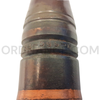
This inert Soviet 37mm round pairs a BR-167 armor-piercing tracer projectile with a brass case dated 1942. Its long ballistic cap, grooved projectile body and visible factory markings give collectors a useful example of Soviet ammunition construction spanning wartime and postwar production. The round is offered with its projectile and case; the primer is absent.
BR-167 Projectile Design
The BR-167 used a hardened steel body to defeat armor, with a long ballistic windshield over its nose to reduce drag. It carried no explosive bursting charge and required no fuze. Service projectiles contained a base tracer to make their flight visible. The two circumferential grooves below the cap identify the grooved version documented in military identification guides. These controlled where the forward body could break during impact, helping protect the main penetrating body. This feature entered the design during 1941. A single copper driving band surrounds the lower body. The historical UBR-167 service round used a 760-gram BR-167 projectile at a muzzle velocity of approximately 850 meters per second.
Case and Factory Markings
The case belongs to the 37×252SR anti-aircraft cartridge family. Its broad head groove retained the round in the gun's five-round charger clip. The headstamp includes 184-С and a date ending 42г, identifying a 1942 case from Plant No. 184, the Sergo factory at Zelenodolsk. This factory supplied cases for Soviet small-caliber artillery during the Second World War. The projectile marking appears to read 33–599–К. Factory code 599 identifies the Yaroslavl projectile plant, while К corresponds to 1956 in the Soviet letter-date system. The copper band also shows a partly legible marking including “2–М.”
Development of the 61-K Anti-Aircraft Gun
The main land weapon associated with this ammunition was the 37mm automatic anti-aircraft gun Model 1939, or 61-K. M. N. Loginov's team at Kalinin Plant No. 8 developed it in 1938 from the preceding 45mm 49-K project, retaining important design features derived from the Swedish Bofors automatic gun. Soviet adoption followed in 1939, with an initial batch of 15 guns completed that year. Larger production orders followed in 1940 as the Red Army expanded its defenses against low-flying aircraft. The decision to concentrate on 37mm and 25mm automatic weapons brought work on the 45mm automatic anti-aircraft gun to an end.
Army and Naval Service
The 61-K served as a mobile anti-aircraft weapon for protecting troops and columns on the march. Its 1942 service manual listed a cyclic firing rate of 160–180 rounds per minute and specifically authorized armor-piercing ammunition for reinforcing anti-tank defense. The BR-167 therefore represents the gun's ground-target role alongside its better-known anti-aircraft work. The same ammunition family also served the Soviet Navy's single-barrel 70-K, adopted in 1940. During the war, these automatic guns gradually replaced older 45mm 21-K mounts. The related twin 37mm V-11 developed from the 70-K and continued into postwar production, extending the ammunition family's naval service.
Condition
All ordnance is inert. Please check the pictures for the general condition of the item.
Ideal For
This round provides a physical reference for studying Soviet factory markings, projectile development and the ammunition shared by land and naval guns.
- Soviet ammunition collections comparing wartime cases and postwar projectiles.
- 61-K, 70-K and V-11 museum or restoration displays.
- Research into BR-167 construction and Soviet manufacturer codes.
Approx length 15", Approx width 2", Approx height 2", Approx weight 2.7lbs.
Pictures are stock images of our inventory. Unless otherwise noted, you will not be receiving the exact item shown in the pictures. The pictures are representative of the item’s general condition. The item you receive might be slightly better, or worse, condition than was shown in the pictures.
Please visit our page about order lead times here: Order Lead Times.