




Description
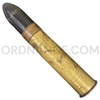
WWII U.S. 37mm M80 Armor-Piercing Tracer Round with Brass Mk III A2 Case, 37×145R
Item Overview
This World War II U.S. cartridge combines an M80 armor-piercing tracer projectile with a brass Mk III A2 cartridge case. It represents the 37×145R aircraft ammunition developed for American cannon-armed fighters, making it a useful addition to a collection focused on wartime aviation armament.
Function and Construction
The M80 used a one-piece steel projectile designed to penetrate armor through the force of impact. It had no fuze or explosive bursting charge. In its original service form, a tracer in the projectile’s base produced a visible trail that helped the pilot observe the path of the gunfire. The designation AP-T means armor-piercing tracer.
M80 Development
The M80 was developed because the existing M51 and M74 armor-piercing projectiles were too long for the M4 aircraft gun. Its construction followed the M74 design, but the projectile was shorter and lighter to suit the aircraft weapon. The Army’s 1944 ordnance catalog listed the M80 as standard ammunition for the M4, alongside separate high-explosive and practice cartridges.
Gun Applications and Development
This cartridge configuration is documented for the 37mm AN-M4 and M10 aircraft cannons. The M4 grew from the experimental T9 gun, which underwent aircraft installation tests in 1939. Continued development produced the M10, standardized in 1944. Its disintegrating-link ammunition feed supported greater ammunition capacity than the M4’s usual endless-belt arrangement. These guns armed versions of the Bell P-39 Airacobra and P-63 Kingcobra.
Aircraft Background and Wartime Service
Bell designed the P-39 around its heavy nose cannon, placing the engine behind the cockpit so the gun could fire through the propeller hub. The aircraft first flew in April 1939 and saw World War II combat in the Southwest Pacific, Mediterranean, and Soviet theaters. The P-63 developed from the P-39 and continued the use of a central 37mm cannon. Many Kingcobras went to Soviet and Free French forces through Lend-Lease, while some served as fighter trainers with the U.S. Army Air Forces.
Condition
All ordnance is inert. Please check the pictures for the general condition of the item.
Ideal For
This round brings the armor-piercing side of American aircraft-cannon development into a focused ammunition or aviation display.
- World War II U.S. ammunition collections
- Bell P-39 Airacobra and P-63 Kingcobra exhibits
- AN-M4 and M10 aircraft-cannon displays
- Research into 37mm armor-piercing ammunition
Approx length 9.5", Approx width 1.75", Approx height 1.75", Approx weight 2.1lbs.
Please visit our page about order lead times here: Order Lead Times.