








Description
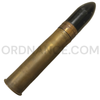
37mm M80 AP-T Round with Mark IIIA2 Brass Case – M4/M10 Aircraft Cannons
Item Overview
This inert 37mm M80 round pairs an armor-piercing projectile with a Mark IIIA2 brass cartridge case dated 1941. The combination belongs to the short-case ammunition family used by the M4 and M10 aircraft cannons. Stamps on the projectile's drive band and case head add identification detail for a collection focused on American aircraft armament and World War II ammunition designs.
Identification and Features
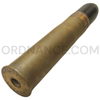
Stamped markings appear on both components. The drive-band inscription identifies the projectile, while the case head records its caliber, model, lot information, initials, and date.
- Caliber: 37mm.
- Projectile model: M80 armor-piercing tracer, or AP-T.
- Case: Mark IIIA2, also written Mark 3A2; brass.
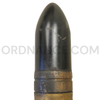
- Projectile drive-band stamp: LOT-E-E-6-11-1994-37MM-M80.
- Case caliber and model stamp: 37MM MK III A2.
- Additional case stamp: LOT-7-U 8-3, S.C. 1941.
- Documented gun applications: M4/AN-M4 and M10 aircraft cannons.
Function and Construction
The M80 was an armor-piercing shot that relied on the impact of its solid steel body to penetrate a target. Its original service design was unfuzed and carried a tracer in a cavity at the base. A gilding-metal rotating band engaged the gun's rifling and gave the projectile its stabilizing spin. The complete service cartridge combined the projectile, case, primer, and propelling charge as one fixed round. The item offered here is an inert collectible.
Documented End-Item Application
Army manual TM 9-1901 identifies the M80 assembled with a Mark IIIA2 case as ammunition for the AN-M4 and M10 aircraft guns. The same M80 projectile also appeared in ammunition for the AN-M9 aircraft gun, where it used the longer M17 case. This example's case designation identifies the short aircraft-cannon configuration. The case and projectile must be considered together when placing an M80 round within its correct ammunition family.
Product History
The M80 was developed because existing 37mm M51 and M74 armor-piercing projectiles were too long for use in the M4 aircraft gun. A shorter projectile met the needs of that weapon. The November 1942 Ordnance School text OS 9-18, Volume II, describes the M80 and illustrates its complete cartridge. The Army's March 1944 Catalog of Standard Ordnance Items lists it as standard ammunition. It filled the armor-piercing role alongside the gun's high-explosive and practice rounds.
Mark IIIA2 Case History
The Mark IIIA2 was the standard brass case for M4 ammunition. Period Army references describe a 5.69-inch case with a projecting rim for extraction. A steel version carried the separate designation Mark IIIA2B1. On this example, the 1941 headstamp dates the brass case to the early wartime period. Its case markings form a separate identification record from the inscription stamped into the projectile's drive band.
Equipment History
The M4 grew from American efforts to fit aircraft with cannon more powerful than machine guns. A Colt automatic cannon was recommended for standardization as the 37mm M4 in December 1939. It became part of a family of automatic, long-recoil aircraft weapons. The M4 commonly used a 30-round endless belt whose links remained together. The later M10 used a disintegrating-link belt and was accepted in April 1944, chiefly for installation in P-63 fighters.
Parent Weapon-System Background
The Bell P-39 Airacobra was a prominent fighter associated with the M4 cannon. First flown in April 1939, it placed its engine behind the pilot, leaving room in the nose for a 37mm gun firing through the propeller hub. The later Bell P-63 Kingcobra continued the use of a nose-mounted 37mm cannon. Their nose installations help explain the need to keep the gun and its ammunition feed compact.
History of Use
The 1942 Ordnance School text describes the M80's intended role as aircraft attacks against lightly armored ground vehicles and waterborne vessels. Its solid-shot design suited that work. The parent P-39 aircraft saw combat in the Southwest Pacific, Mediterranean, and Soviet theaters. Bell built 9,584 Airacobras before production ended in August 1944, with 4,773 sent to the Soviet Union through Lend-Lease. This wider aircraft history places the M80 design within the large wartime effort to supply cannon-armed fighters.
Naval Use of the M4 Cannon
The parent gun also gained a role at sea. A wartime Navy administrative history credits the South Pacific motor torpedo boat command with pioneering the use of M4 37mm guns aboard its boats. Adapting an aircraft cannon for PT boat service expanded the gun's use beyond its original setting. This naval connection adds another historical context for collections of M4 weapons and their short-case ammunition.
Condition
Please check the pictures for the general condition of the item.
Ideal For
This marked M80 round suits exhibits explaining the relationship between an aircraft cannon, its projectile, and its cartridge case. The separate component stamps also make it useful for reference collections organized by ammunition model, case type, and date.
- U.S. 37mm ammunition collectors.
- M4 and M10 cannon displays.
- P-39 and P-63 aviation exhibits.
- Aircraft-armament reference collections.
- Museums and military-history researchers.
Approx length 9.5", Approx width 1.5", Approx height 1.5", Approx weight 2.1lbs.
Pictures are stock images of our inventory. Unless otherwise noted, you will not be receiving the exact item shown in the pictures. The pictures are representative of the item’s general condition. The item you receive might be slightly better, or worse, condition than was shown in the pictures.
Please visit our page about order lead times here: Order Lead Times.