




Description
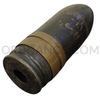
WWII U.S. 37mm M80 Armor-Piercing Tracer Projectile — 1944
Product Overview
This U.S. 37mm M80 armor-piercing tracer projectile is dated 1944. Its official period designation was “Shot, A.P., 37-mm, M80.” This World War II ammunition component connects American ordnance production with the aircraft cannons carried by Bell Airacobra and Kingcobra fighters.
Identification and Features
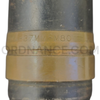
The band markings identify the projectile model, manufacture year, and lot. Its black finish and pointed, armor-piercing nose document the M80 projectile.
- Model marking: “37-MM-M80.”
- Date marking: “1944.”
- Lot marking: “LOT-E E-1-48.”
- Rotating band: One broad gilding-metal band with a groove around its center, giving the appearance of two bands.
- Base: A small opening corresponding to the historical tracer cavity.
Function and Contents
In its original service form, the M80 used a solid steel body to defeat targets through impact and penetration. It carried no explosive bursting charge and required no fuze. A red tracer in the base produced a visible trail that helped crews follow their fire. The gilding-metal rotating band engaged the gun's rifling to spin the projectile and help seal the bore during firing.
Product History
The M80 was developed because the existing M51 and M74 armor-piercing projectiles were too long for the M4 aircraft cannon. A shorter projectile gave that weapon an armor-piercing option suited to its ammunition system. The Ordnance School's November 1942 ammunition text already described the M80, and the Army's March 1944 ordnance catalog listed it as standard ammunition for the M4. This example belongs to that established wartime production period.
Documented End-Item Applications
TM 9-240, dated May 7, 1945, documents M80 ammunition for the 37mm AN-M4 and M10 aircraft cannons in the 37×145mmR cartridge family. The March 1944 ordnance catalog also lists the M80 as substitute-standard ammunition for the M9 automatic cannon, assembled with the longer M17 cartridge case in the 37×223mmSR family. These are separate complete-round applications of the same projectile model. The offered item is the projectile component.
Equipment History
The M4 and M10 were fully automatic aircraft cannons using a long-recoil operating system. A key difference was their ammunition feed equipment. The AN-M4 commonly used a 30-round endless belt whose links remained connected. The M10 used a disintegrating-link belt and could be configured for feeding from either side. These changes show how the cannon family evolved to meet aircraft installation and ammunition-handling needs while retaining the M80 among its authorized projectiles.
Weapon System Background
The Bell P-39 Airacobra combined an engine mounted behind the pilot with a nose cannon firing through the propeller hub. This layout placed heavy armament along the aircraft's centerline. The P-63 Kingcobra developed the same general arrangement in a revised fighter design. Depending on the aircraft variant, the M4 or M10 supplied its 37mm cannon armament, supported by additional machine guns.
History of Use
The Ordnance School described the M80's intended targets as lightly armored ground vehicles and watercraft. Its parent aircraft family had a wider wartime career: P-39s fought in the Southwest Pacific, Mediterranean, and Soviet theaters. Both Airacobras and Kingcobras reached Allied forces through Lend-Lease, with the Soviet Union a major recipient. The U.S. Army Air Forces used some P-63s for fighter training but did not employ that aircraft in combat.
Condition
All ordnance is inert. Please check the pictures for the general condition of the item.
Ideal For
This dated projectile suits collectors studying American aircraft ammunition, wartime production markings, and the development of specialized armor-piercing shot. Its readable identification and grooved rotating band make it useful for a display explaining the differences among U.S. 37mm projectile designs.
- World War II U.S. ammunition collections.
- Bell P-39 Airacobra and P-63 Kingcobra exhibits.
- M4, M10, and M9 cannon-history displays.
- Ordnance marking and projectile-construction studies.
Approx length 4.5", Approx width 1.5", Approx height 1.5", Approx weight 1.7lbs.
Please visit our page about order lead times here: Order Lead Times.