





Description
U.S. 37mm M80 Armor-Piercing Tracer Shot Projectile for 37×223SR and 37×145R Cartridges
Item Overview
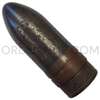
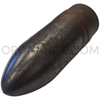
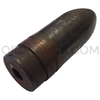
This original U.S. 37mm M80 armor-piercing tracer shot projectile is a loose World War II-era cannon projectile. The M80 projectile was used in two different fixed-cartridge configurations: the long 37×223SR round for the AN-M9 automatic cannon and the shorter 37×145R round for the AN-M4 and M10 aircraft cannons. This listing is for the projectile only, not a complete cartridge.
Identification and Construction
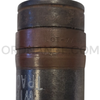
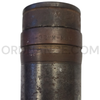
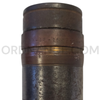
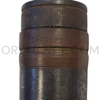
The projectile is marked “37MM M80” and “SHOT AP-T M80 TRACER.” It has an uncapped, one-piece steel shot body, a short rounded nose, a square base, and copper-alloy rotating-band material near the rear. The original service design measured approximately 4.23 inches long and used a base tracer so the gunner could observe the projectile’s path. The armor-piercing body contained no explosive bursting charge.
Two Cartridge Configurations
Army Technical Manual TM 9-1901 documents the same M80 projectile in two cartridge families. For the AN-M9 cannon, it was assembled in the long grooved M17 brass case, commonly identified as 37×223SR. For the AN-M4 and M10 aircraft cannons, it was loaded in the shorter Mk IIIA2 brass or Mk IIIA2B1 steel case, commonly identified as 37×145R. The cases and propelling charges differed, but both rounds used the same basic 4.23-inch M80 shot.
Function and Historical Performance
The M80 relied on its hardened steel body and high impact speed to defeat armor rather than using an explosive charge. The rotating band engaged the cannon’s rifling and stabilized the shot in flight, while the original tracer composition produced a visible path for fire correction. Wartime manuals list a muzzle velocity of approximately 3,050 feet per second for the long AN-M9 cartridge and 1,825 feet per second for the shorter AN-M4/M10 cartridge, although some earlier short-case ammunition was rated at 1,650 feet per second.
Weapons-System History
The AN-M4 and M10 were compact 37mm automatic aircraft cannons developed for American fighter-aircraft armament during World War II. Their shorter ammunition balanced projectile power with the size and weight limits of an aircraft installation. The AN-M9 was a larger, higher-velocity cannon that used the longer M17 case and a heavier propelling charge. Together, these systems show how one armor-piercing projectile could be adapted to automatic cannons with different performance requirements.
History of Use
M80 AP-T ammunition was intended for engaging armored vehicles, equipment, aircraft, and other resistant material targets. The shorter cartridge served aircraft-cannon installations, while the long AN-M9 cartridge provided greater velocity and armor penetration. These rounds formed part of the rapid development of U.S. automatic-cannon ammunition during World War II, when aircraft and other weapons platforms required more power than rifle-caliber machine guns could provide.
Condition and Included Item
This is an original military-surplus projectile that may show finish loss, scratches, oxidation, staining, faded lettering, band marks, and other evidence of age or handling. No cartridge case, primer, propellant, cannon, or other components are included. Although the shot body has no explosive bursting charge, the original design included pyrotechnic tracer composition in its base; the tracer-cavity condition of this specimen has not been confirmed from the photographs. Do not drill, grind, heat, or disassemble the projectile.
Approx length 4.5", Approx width 1.5", Approx height 1.5", Approx weight lbs.
Pictures are stock images of our inventory. Unless otherwise noted, you will not be receiving the exact item shown in the pictures. The pictures are representative of the item’s general condition. The item you receive might be slightly better, or worse, condition than was shown in the pictures.
Please visit our page about order lead times here: Order Lead Times.