





Description
U.S. WWII 37mm M63 High-Explosive Round with Frankford Arsenal M16 Brass Case
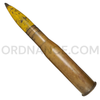
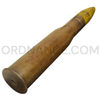
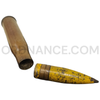
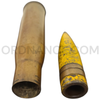
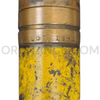
This U.S. WWII 37mm M63 high-explosive round consists of an M63 projectile bearing the manufacturer marking “LM” and an M16 brass cartridge case manufactured by Frankford Arsenal. Both the projectile and cartridge case carry 1942 dates. Offered inert for collection and display, it is well suited to collections of American tank ammunition, antitank equipment, and wartime arsenal production. Still contains a nice amount of its original early WW2 yellow high-explosive paint!
M63 Development and Purpose
The M63 replaced the earlier Mk. II high-explosive shell in U.S. 37mm tank and antitank ammunition. It supplied blast and fragmentation effects for infantry support and engagements against field positions, trucks, and lightly armored vehicles. The original service design used a steel projectile with a solid, elongated nose and an M58 base-detonating fuze. Locating the fuze at the base allowed the shell to retain its solid nose. The M63 served alongside armor-piercing and canister ammunition, giving gun crews several ammunition types for different battlefield roles.
Tank and Antitank Gun Applications
The 37×223R M63 round with the M16 case was used in the M3 and M3A1 towed antitank guns and the related M5, M5A1, and M6 tank guns. Vehicle applications included the M3 and M5 Stuart light-tank families, the turret-mounted 37mm gun in M3 Lee and Grant medium tanks, and the M6 gun carried by the M8 Greyhound armored car. This shared ammunition family supported infantry antitank units, tank formations, and armored reconnaissance crews.
Frankford Arsenal and Wartime Production
Established in Philadelphia in 1816, Frankford Arsenal began as an ammunition depot and repair facility before becoming a major center for military ammunition development and manufacture. Its WWII responsibilities included artillery projectiles, cartridge cases, small-arms ammunition, and precision instruments. The arsenal also provided technical assistance and training to private manufacturers as American ammunition production expanded. Its cartridge-case production was part of the large industrial effort needed to equip the growing U.S. military.
Development of the 37mm Gun Family
The M3 antitank gun emerged from the Army’s efforts during the 1930s to give infantry a compact weapon for defense against armored vehicles. Its light carriage made it practical to tow and allowed crews to move it short distances by hand. The related M5 adapted the gun for tank installation, while the M6 introduced an automatically opening breech. These developments placed a common 37mm ammunition family in both towed weapons and armored vehicles.
Wartime Service
Stuart tanks served with U.S. and Allied forces in North Africa, Europe, and the Pacific. Their duties included combat, reconnaissance, flank security, and infantry support. As German armor became heavier, the Stuart’s European role increasingly favored scouting and security work, while its smaller size remained useful in Pacific operations. The M8 Greyhound entered combat in Italy in 1943 and carried the same caliber into armored reconnaissance service. High-explosive ammunition such as the M63 helped these weapons support troops against targets beyond enemy tanks.
Condition
All ordnance is inert. Please check the pictures for the general condition of the item.
Ideal For
Suitable for focused displays of American 37mm ammunition and the equipment it supported.
- WWII tank and antitank ammunition collections
- M3 and M5 Stuart tank exhibits
- M3 Lee, Grant, and M8 Greyhound displays
- Frankford Arsenal and wartime manufacturing collections
Approx length 14.5", Approx width 2", Approx height 2", Approx weight 2.2lbs.
Pictures are stock images of our inventory. Unless otherwise noted, you will not be receiving the exact item shown in the pictures. The pictures are representative of the item’s general condition. The item you receive might be slightly better, or worse, condition than was shown in the pictures.
Please visit our page about order lead times here: Order Lead Times.