






Description
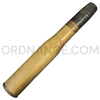
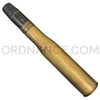
U.S. WWII 37mm M59 APC-T Round with 1942 M17 Brass Case
This U.S. World War II 37mm M59 armor-piercing capped tracer round features a 1942-dated M17 brass case, an M23A1 percussion primer, and a projectile bearing a 1943 production marking. Its capped projectile has the M59’s characteristic nose without a windscreen. Offered inert for collection and display, it is a fitting piece for collectors of American antiaircraft and armor-piercing ammunition.
Identification & Features
The round belongs to the 37×223SR ammunition family. Its projectile, cartridge case, and primer carry separate identification and production markings.
- Projectile designation: “37MM M59.”
- Projectile production marking: “018-1-72-1943,” including the 1943 date.
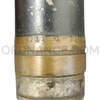
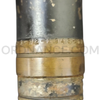
- Case head: “37MM M17,” “1942,” and “LOT 22068-13,” with the additional marking “SF.R.”
- Primer: “M23A1” and “LOP 1-22578.”
M59 Design and Development
The M59 was closely related to the M51 armor-piercing capped shot used in U.S. 37mm tank and antitank guns. It retained an armor-piercing body, a cap intended to aid penetration, and a tracer for observing flight. The M59 omitted the M51’s streamlined windscreen because the M1A2 automatic gun’s chambering mechanism required a shorter nose. The later M59A1 continued the same armor-piercing role with changes to the cap attachment, case crimping, and primer.
Documented Gun Applications
The M59 provided armor-piercing ammunition for the 37mm M1A2 automatic antiaircraft gun, giving its crews a round for armored ground targets alongside their high-explosive ammunition. The gun was used on four-wheel trailer carriages and in the M15 and M15A1 half-track mounts, which paired it with two .50-caliber machine guns. Wartime ammunition catalogs also list the M59 for the AN-M9 aircraft cannon in a separate service loading.
Gun History and Wartime Use
The M1-series automatic guns grew from John Browning’s 1920s development work, continued by Colt after his death. The M1A1 was standardized in 1938, and the M1A2 followed in 1939 with revised rifling. These guns served U.S. Army antiaircraft units during World War II. Their half-track installations provided mobile protection for troops and vehicle columns; reports from North Africa described their value in forward areas and along roads exposed to air attack. The Army also adopted the Swedish-designed 40mm Bofors as it expanded its light antiaircraft armament during the war.
Condition
The M59 projectile is seated in the marked M17 brass case with the M23A1 primer present. All ordnance is inert. Please check the pictures for the general condition of the item.
Ideal For
A useful example for comparing American capped armor-piercing projectiles and the ammunition used by wartime automatic antiaircraft guns.
- U.S. WWII 37mm ammunition collections.
- M1A2 gun and M15-series half-track displays.
- Comparison of M51, M59, and M59A1 projectile designs.
- Research into wartime case, primer, and projectile markings.
Approx length 13", Approx width 2", Approx height 2", Approx weight 2.8lbs.
Please visit our page about order lead times here: Order Lead Times.