






Description
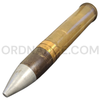
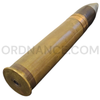
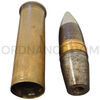
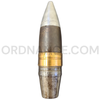
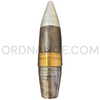
WWII U.S. 37mm M55A1 Target Practice–Tracer Cartridge with M50 Dummy Fuze
Product Overview
This U.S. World War II 37×145mmR M55A1 target practice–tracer cartridge is assembled with an M50 dummy fuze and a Mk IIIA2 brass cartridge case. Its markings preserve early wartime component dates and production information. This configuration belongs to the ammunition family used by the 37mm M4 aircraft automatic cannon.
Identification and Features
The markings identify the projectile, nose fitting, case, and primer separately, preserving the following component information.
- Projectile driving band: “LOT 1-22707-2-42-R.T.CO. -37MM – M55A1.”
- Projectile date: “2-42,” consistent with February 1942 manufacture.
- Nose fitting: “FUZE, DUMMY, M50.”
- Case head: “37MM MK III A2,” “S.C. 1941,” and “LOT 708-2.”
- Primer: “WC M23A1 1941 1993-2,” identifying the M23A1 model, a 1941 date, and additional production markings.
Function and Contents
The M55A1 reproduced the M54 high-explosive projectile's general shape, weight, and flight characteristics for gunnery practice. Its forward cavity contained no bursting charge. A separate cavity in the base held the tracer, allowing crews to follow the projectile's path. The two cavities were not connected. This arrangement provided a practice projectile with flight behavior similar to the service shell.
M50 Dummy Fuze
The period M50 was a solid aluminum-alloy nose fitting shaped to simulate the M54's M56 service fuze. It supplied the required nose profile without an explosive fuze mechanism. The original M55A1 cartridge was intended for practice firing and included a functioning primer, propellant, and tracer.
Product History
The M55A1 was already described in the Ordnance School's November 1942 ammunition text as part of the M4's authorized ammunition family. It served alongside high-explosive and armor-piercing ammunition, giving crews a dedicated practice loading. This example's case and primer bear 1941 dates, while the projectile carries an apparent February 1942 date. These markings record the production of individual components rather than a single manufacture date for the assembled cartridge.
Documented End-Item Applications
Period references, including TM 9-240 and TM 9-1901, document the M55A1 practice loading for the M4/AN-M4 and M10 aircraft cannons. The Mk IIIA2 brass case is a short, rimmed case associated with 37×145mmR aircraft ammunition. M55A1 projectiles also appeared in other cartridge configurations, making the case designation important when identifying a complete round. The principal aircraft association for the M4 is the Bell P-39 Airacobra.
Cartridge Case and Primer History
The Mk IIIA2 designation identifies the cartridge case, while M55A1 identifies the practice projectile. The installed primer bears the earlier M23A1 designation. Wartime ammunition inspection guidance notes that some aircraft rounds remained fitted with M23A1 primers after the M23A2 became standard. The separate case and primer markings illustrate the component-level records used to track ammunition production.
Equipment History
The M4 and M10 were fully automatic aircraft cannons using a long-recoil operating system. The AN-M4 commonly used a 30-round endless ammunition belt whose links remained connected. The M10 adopted a disintegrating-link feed and could be configured to feed from either side.
Weapon System Background
The Bell P-39 Airacobra placed its engine behind the pilot, leaving room in the nose for heavy armament. Its M4 cannon fired through the propeller hub, with machine guns providing additional firepower. This arrangement concentrated the main weapon along the aircraft's centerline.
History of Use
M55A1 ammunition supported firing practice and marksmanship training for crews using the aircraft-cannon system. The P-39 itself fought in the Southwest Pacific, Mediterranean, and Soviet theaters during World War II. Large numbers reached the Soviet Union through Lend-Lease. The cartridge represents the training side of that wider service history, when practice ammunition helped prepare crews to use cannon-equipped fighters.
Condition
All ordnance is inert. Please check the pictures for the general condition of the item.
Ideal For
This cartridge suits collectors studying World War II aircraft armament, practice ammunition, and component markings. Its dated case and primer, marked projectile, and M50 nose fitting provide several distinct features for an educational display.
- U.S. 37mm aircraft-ammunition collections.
- Bell P-39 Airacobra and M4 cannon exhibits.
- World War II gunnery-training displays.
- Studies of cartridge cases, primers, and dummy fuzes.
Approx length 9.5", Approx width 1.75", Approx height 1.75", Approx weight lbs.
Please visit our page about order lead times here: Order Lead Times.