





Description
37mm M54 HE-T Round with Mark IIIA2 Brass Case and M56 Nose Fuze – M4/M10 Aircraft Cannons
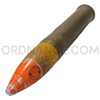
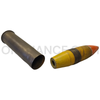
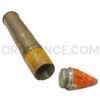
This 37mm M54 round combines an M54 projectile, Mark IIIA2 brass cartridge case, and M56 nose fuze. The design belongs to the ammunition used by American M4 and M10 aircraft cannons during World War II. This inert collectible is a useful centerpiece for an aviation ordnance display, with the main components assembled in their familiar service-round form.
Identification and Features
The case designation supplied as Mark 3A2 appears in period Army references as Mk. IIIA2. This short, rimmed brass case is an important identifying feature of the aircraft-cannon cartridge.
- Caliber: 37mm.
- Projectile: M54 high-explosive tracer design.
- Nose fuze: M56 point-detonating fuze.
- Cartridge case: Mark IIIA2, also written Mark 3A2.
- Case material: Brass.
- Historical gun applications: M4/AN-M4 and M10 aircraft cannons.
Function and Contents
The M54 was issued as fixed ammunition, meaning the projectile and cartridge case formed one complete unit. Its original service role was to damage aircraft and other light targets through the blast and fragments of a high-explosive shell. The case held the propelling charge and primer, while the projectile carried the bursting charge and tracer. The nose fuze controlled impact functioning. These roles explain the parts in the original military design; the collectible offered here is inert.
Product History
The M54 was an established wartime ammunition design by 1942, when the Ordnance School described it in OS 9-18, Volume II. The Army's March 1944 Catalog of Standard Ordnance Items listed it as standard high-explosive ammunition for the M4 aircraft gun. It belonged to a family that also included M80 armor-piercing ammunition and M55A1 practice ammunition. Each type served a different purpose within the same gun system. Period records list tetryl and an alternate Composition A explosive filling for the M54 service projectile.
Documented Applications
Army manual TM 9-240 lists the M54 high-explosive tracer round with a shell-destroying feature as authorized ammunition for both the AN-M4 and M10 aircraft guns. The Mark IIIA2 case places this example in that short-case aircraft family. The same M54 projectile and M56 fuze also appeared in ammunition for the M1A2 antiaircraft gun and AN-M9 aircraft gun, but those complete rounds used the longer M17 case. The case designation is therefore essential when identifying an M54 round's intended weapon.
Mark IIIA2 Cartridge Case History
The Mark IIIA2 was the standard brass case for M4 ammunition. Period Army references give its case length as 5.69 inches and describe a projecting rim used by the gun's extractor. A steel version, the Mark IIIA2B1, was listed as substitute standard. These separate designations help collectors distinguish the two case materials within the same ammunition family.
M56 Nose Fuze Overview
The M56 was a point-detonating fuze, meaning it responded to impact at the projectile's nose. Army references describe it as both supersensitive and superquick. In plain terms, it was designed to respond to light aircraft materials and initiate the shell's burst promptly. Its main exterior parts were made from aluminum alloy. Together, its sensitivity and quick action supported the M54's role against aircraft.
Projectile Construction and Tracer History
The original M54 projectile was made from machined steel with a tapered base and a gilding-metal rotating band. The band engaged the gun's rifling, which gave the projectile its stabilizing spin. A tracer in the base produced a visible red trace. It also served a second purpose: if the shell missed its target, the tracer system was designed to cause the projectile to destroy itself after its burn ended. This shell-destroying feature addressed the risk of an intact explosive projectile falling onto friendly territory.
Equipment History
American work on automatic aircraft cannon began well before World War II. Army ordnance histories describe a renewed series of aircraft-armament tests in 1936, followed by requests for cannon with more destructive effect than machine guns. In December 1939, a Colt automatic cannon was recommended for standardization as the 37mm M4. Wartime development then led to the M10, which was accepted in April 1944 chiefly for installation in the nose of P-63 fighters. Its revised ammunition feed was better suited to aircraft installation.
Weapon-System Background
The M4 and M10 were automatic aircraft cannons of the long-recoil type. The M4 commonly used a 30-round endless belt whose links stayed together. The M10 used a disintegrating-link belt and could be arranged to feed from either side. The Bell P-39 Airacobra was a prominent aircraft associated with this cannon family. Its engine sat behind the pilot, leaving room in the nose for a 37mm cannon that fired through the propeller hub. The later P-63 Kingcobra continued the use of a nose-mounted 37mm cannon.
History of Use
The M54's aircraft-cannon background connects it with the P-39's wartime service in the Southwest Pacific, Mediterranean, and Soviet theaters. The Airacobra first flew in April 1939 and was among America's front-line pursuit aircraft when the United States entered the war. Production ended in August 1944 after 9,584 aircraft had been built, with 4,773 sent to the Soviet Union through Lend-Lease. These aircraft records show the broad wartime setting of the ammunition design.
Naval Use of the M4 Cannon
The M4 also gained a role beyond aircraft. A wartime Navy administrative history credits the South Pacific motor torpedo boat command with pioneering the use of the M4 37mm gun aboard its boats. This adaptation brought an aircraft weapon into the close coastal fighting carried out by PT boats. It adds a naval chapter to the parent gun's service history and gives the short-case ammunition family relevance to displays about Pacific small-boat warfare.
Condition
Assess the projectile, fuze, case, finish, and visible markings together when choosing this round for a collection. Please check the pictures for the general condition of the item.
Ideal For
This 37mm M54 collectible suits displays that explain how wartime aircraft ammunition combined a projectile, fuze, and cartridge case. It can also complement related practice rounds and case variants in a reference collection, helping viewers compare the different ammunition roles.
- U.S. 37mm ammunition collections.
- P-39 and P-63 aviation exhibits.
- M4 and M10 cannon displays.
- PT boat history displays.
- Museum and educational collections.
Approx length 10", Approx width 1.5", Approx height 1.5", Approx weight 1.6lbs.
Pictures are stock images of our inventory. Unless otherwise noted, you will not be receiving the exact item shown in the pictures. The pictures are representative of the item’s general condition. The item you receive might be slightly better, or worse, condition than was shown in the pictures.
Please visit our page about order lead times here: Order Lead Times.