




Description
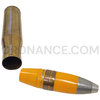
U.S. WWII 37mm M54 High-Explosive Round with M56 Fuze and M17 Brass Case
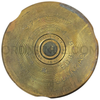
This U.S. WWII-era 37mm M54 high-explosive round features an M56 point-detonating fuze and a Frankford Arsenal M17 brass cartridge case marked for the M1A2 automatic gun. Its M23A1 primer is dated 1940. Offered inert for collection and display, it represents the shell-destroying tracer ammunition used by American 37mm automatic antiaircraft guns.
Identification & Features
This round belongs to the 37×223SR ammunition family. The 1940 marking dates the primer, while the case carries its own model, gun designation, arsenal mark, and lot number.
- “37 MM M17”: Caliber and brass cartridge-case model.
- “AUTO GUN M1A2”: Intended automatic gun.
- “LOT 3564-8”: Cartridge-case lot number.
- “F.A.”: Frankford Arsenal, Philadelphia, Pennsylvania.
- “E.D.B.”: Additional case marking.
- “M23A1 / 1940” on primer: Percussion-primer model and manufacture year.
M54 High-Explosive and Tracer Role
The M54 was designed for use against aircraft and other light targets. Its M56 nose fuze provided impact action, allowing the shell to burst when it struck a target. The shell-destroying tracer served two purposes: it made the projectile’s flight visible and was intended to destroy a shell that had missed its target. This reduced the hazard from intact high-explosive rounds falling back to the ground after antiaircraft fire.
Ammunition Development
Army complete-round charts revised in 1941 already listed the M54 for issue and manufacture for the M1A2 gun. The design continued through World War II, with M55A1 practice ammunition providing a training counterpart that matched the service projectile’s general shape and weight. The later M54A1 retained the high-explosive tracer role with revised ignition and tracer components. M54 projectiles also appeared in ammunition for the M4 and AN-M9 aircraft cannon, using the case and loading specified for each weapon.
The M1A2 Gun and Wartime Service
The M1-series 37mm automatic antiaircraft gun grew from John Browning’s work in the 1920s, continued by Colt after his death. The M1A1 was standardized in 1938, followed by the M1A2 with revised rifling in 1939. Intended to engage low-flying aircraft, the M1A2 served on four-wheel trailer carriages and in the M15 and M15A1 half-track mounts. The half-tracks paired the cannon with two .50-caliber machine guns for mobile protection of troops and vehicle columns. U.S. Army reports from North Africa described their use in forward areas and along roads exposed to air attack. The Army also adopted the Swedish-designed 40mm Bofors as its light antiaircraft armament expanded during the war.
Condition
The M54 projectile is fitted with the M56 fuze and seated in the marked M17 brass case, with the M23A1 primer present. All ordnance is inert. Please check the pictures for the general condition of the item.
Ideal For
A useful example for collections and exhibits tracing the development of American automatic antiaircraft ammunition and its wartime manufacturing marks.
- U.S. WWII 37mm ammunition collections.
- M1A2 gun and M15-series half-track displays.
- Frankford Arsenal cartridge-case collections.
- Comparison of M54 service rounds and M55A1 practice ammunition.
Approx length 12", Approx width 2", Approx height 2", Approx weight 2.1lbs.
Please visit our page about order lead times here: Order Lead Times.