




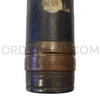
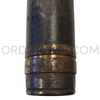
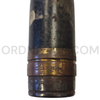


Description
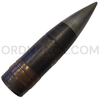
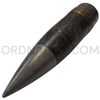
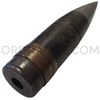
WWII U.S. 37mm M51 Armor-Piercing Capped Tracer Projectile, 37×223R
Item Overview
This original U.S. 37mm M51 armor-piercing capped tracer projectile was used in 37×223R ammunition for World War II-era tank and antitank guns. Its official ammunition classification was Armor-Piercing Capped with Tracer, commonly shortened to APC-T. This listing is for the projectile only; no cartridge case, primer, propellant, weapon, or other components are included.
Identification and Construction
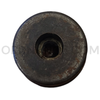
The original M51 design combined a hard steel body, a softer steel armor-piercing cap, and a lightweight windshield or false ogive. The pointed cap helped the projectile engage hardened armor, while the windshield gave it a longer and more aerodynamic shape. The projectile was solid except for a small tracer cavity in its base. On the original M51 variant, this cavity was closed by a steel washer crimped to the projectile body; later M51B1 and M51B2 versions used a metal closing disk.
Dimensions and Cartridge
TM 9-1901 lists the service projectile at approximately 6.36" long with a 0.74"-wide rotating band and square base. It was assembled with an 8.75" M16 cartridge case to form a complete 37×223R round measuring approximately 14.53" long. The complete service cartridge weighed about 3.41 lbs., although this listing does not include the cartridge case or its original internal components.
Function and Historical Performance
The M51 defeated armor through impact force and penetration rather than an explosive charge. Its armor-piercing cap reduced damage to the hardened body when striking face-hardened steel, while the rotating band sealed the bore and engaged the gun’s rifling. The original red tracer burned for approximately three seconds, equal to about 2,300 yards of flight. Period Army data lists penetration at 1,000 yards and zero-degree obliquity as approximately 2.1" of face-hardened armor or 2.3" of homogeneous armor under test conditions.
Weapons-System History
The M51 round was used with the U.S. 37mm M3, M3A1, M5, M5A1, and M6 guns. The M3 and M3A1 were towed antitank guns fielded during the early part of World War II. The related M5, M5A1, and M6 guns armed American tanks and armored vehicles, including light tanks, the 37mm turret of the M3 medium tank family, and vehicles such as the M8 armored car.
History of Use
M51 APC-T ammunition was developed for use against light armor and similar material targets. Its capped construction gave it better performance against face-hardened plate than simpler uncapped projectiles such as the M74. Although heavier enemy tanks eventually reduced the value of 37mm guns as primary antitank weapons, they remained useful against light vehicles, equipment, firing positions, and other targets throughout World War II.
Condition and Safety
This original military-surplus projectile may show oxidation, discoloration, scratches, finish loss, worn markings, rotating-band damage, and other evidence of age or storage. The armor-piercing body contains no explosive bursting charge, but the original design included pyrotechnic tracer composition in its base. The tracer-cavity condition of this specimen has been confirmed empty
Approx length 6.5", Approx width 1.5", Approx height 1.5", Approx weight lbs.
Pictures are stock images of our inventory. Unless otherwise noted, you will not be receiving the exact item shown in the pictures. The pictures are representative of the item’s general condition. The item you receive might be slightly better, or worse, condition than was shown in the pictures.
Please visit our page about order lead times here: Order Lead Times.