



Description
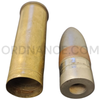
U.S. Navy Heavy 1-Pounder Cartridge Assembly with December 1898 U.M.C. Case
This inert U.S. Navy 37mm Heavy 1-Pounder cartridge assembly features a Union Metallic Cartridge Company case manufactured in Bridgeport, Connecticut. It represents the small-caliber naval ammunition used during America's expansion into a modern steel navy. Its dated manufacturer’s headstamp adds a clear point of identification for collectors of early naval ordnance.
Identification and Headstamp Markings
The cartridge family is designated 37×136R and is also cataloged as 37×137R. The letter R identifies a rimmed case. The headstamp records the case manufacturer, factory location, and manufacture date:
- U.M.C. CO.: Union Metallic Cartridge Company.
- BRIDGEPORT CONN. U.S.A.: Manufacturer’s location in Bridgeport, Connecticut.
- 12–98: December 1898 case manufacture date.
Function of the Cartridge Assembly
The original ammunition type used a fixed cartridge, combining the projectile, propelling charge, and primer into one unit for loading. The case held the propelling components and helped seal the chamber during firing. Its projecting rim provided a surface for extraction. This arrangement supported the quick handling that made small naval rapid-fire guns useful aboard ship.
Product History: A Case from December 1898
The case was manufactured during the month the Treaty of Paris was signed on December 10, 1898. Hostilities between the United States and Spain had ended that August. Its date therefore places case production at the close of the Spanish-American War era, when the Navy was moving from wartime operations into a period of wider overseas commitments.
Manufacturer History: Union Metallic Cartridge Company
Union Metallic Cartridge Company was established in 1867 by Marcellus Hartley, an arms dealer who recognized the growing demand for metallic cartridges. The company developed its manufacturing operations in Bridgeport and employed Alfred C. Hobbs to advance its production machinery. U.M.C. became an important part of Connecticut's ammunition industry, giving this case a connection to both naval history and American manufacturing.
Documented Application: Heavy Naval One-Pounder Guns
This cartridge family is associated with U.S. Navy heavy one-pounder rapid-fire guns, including the heavy Hotchkiss type. The Navy's 1900 Manual of Instruction in Ordnance and Gunnery distinguishes the light and heavy Hotchkiss guns and describes the heavy version as being in service throughout the fleet. That contemporary reference establishes the principal naval equipment context for this ammunition family.
Equipment History: Development of the Heavy Hotchkiss
Naval literature published in 1894 already reported that the light one-pounder was to be withdrawn and the heavy type had become the service gun of that caliber. The heavy gun offered higher muzzle velocity while retaining the 37mm bore. Its construction included a tube, jacket, and locking ring, with a vertically moving breechblock.
Weapon-System Background: A Warship's Secondary Armament
One-pounder guns formed part of the smaller weapons carried alongside a warship's main battery. An 1894 Naval Ordnance article listed six one-pounders in the armament of the battleships Indiana, Massachusetts, and Oregon. Their inclusion shows how compact rapid-fire artillery fitted into a layered naval armament, supporting ships equipped with much larger guns.
History of Use: Fleet Service and Gunnery Instruction
Alongside their shipboard role, Hotchkiss one-pounders served in naval instruction. The Navy's 1900 manual used these guns to teach apprentices the mechanism, crew duties, and care of equipment. Training included identifying parts and practicing the replacement of damaged components. These documented activities show the one-pounder's place in preparing sailors to maintain and operate naval artillery.
Condition and Inert Status
All ordnance is inert. Please check the pictures for the general condition of the item.
Ideal For
The manufacturer and date markings make this assembly useful for collections organized by ammunition maker and production period. It can also accompany period manuals and naval exhibits that explain the connection between American cartridge production and the development of rapid-fire shipboard guns.
- U.S. Navy and maritime history collections
- Union Metallic Cartridge Company memorabilia
- Spanish-American War era exhibits
- Early artillery ammunition studies and educational displays
Approx length 8.5", Approx width 1.75", Approx height 1.75", Approx weight 1.75lbs.
Please visit our page about order lead times here: Order Lead Times.