






Description
Austro-Hungarian 37mm High Explosive Round for the M.15 Infantry Gun
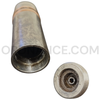
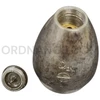
This inert Austro-Hungarian 37mm round combines a 1915-dated Georg Roth brass case with a steel projectile featuring two copper driving bands and a separate nose assembly. The 37×57R cartridge belongs to the ammunition family developed for the Škoda 3.7 cm Infanteriegeschütz M.15, a compact infantry support gun introduced during World War I. Its visible markings and removable components make it a useful example for collectors studying Austro-Hungarian ammunition and trench warfare.
Identification and Features
The intertwined GR monogram identifies Georg Roth as the case manufacturer. The female-profile marks on the projectile body and nose are consistent with the Poldi steelworks at Kladno. The case’s 1915 date identifies that component’s manufacture.
- Cartridge designation: 37×57R, associated with the 3.7 cm Infanteriegeschütz M.15.
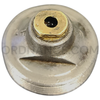
- Brass case head marked with the GR monogram, S, 9, and 1915.
- Steel projectile with two narrow copper driving bands and body markings including 16, 8, and 629.
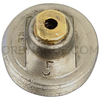
- Separate nose assembly bearing a female-profile emblem, K, and 5.
- Internal threaded partition marked KE, with the removable components shown in the photographs.
Projectile Design and Historical Function
The separate nose chamber and internal partition are consistent with the Brisanzgranate, also described as an Absprenggranate, used by the M.15. This was an unusual bouncing high-explosive shell. The Austro-Hungarian Army’s 1916 regulations describe its as lifting the projectile body after impact so that it burst approximately 1–4 meters above the ground. This placed the burst above ground level to improve its effect against personnel and field cover. The same regulations distinguish this ammunition from the Minengranate, intended to burst after penetrating cover.
Development of the M.15 Infantry Gun
Škoda developed the M.15 at Plzeň in response to the demands of trench warfare. Infantry needed a small gun capable of attacking machine-gun positions, observation posts, and field defenses at distances where supporting artillery could endanger friendly troops. Trials took place on the southwestern front in October 1915, followed by adoption late that year. The first 60 guns reached units by the end of February 1916. Infantry regimental gun detachments initially received two guns and later four, giving the infantry its own close-support artillery.
Construction, Transport, and Service
The M.15 used a short barrel, a vertical sliding breechblock, a recoil system, and a tripod mounting. Its periscopic sight allowed the gunner to aim while remaining behind cover. Three men directly served the gun, with additional personnel supporting ammunition supply and movement. Separate carrying loads allowed transport by men or pack animals through difficult terrain; dog-drawn carts were also provided for. The weapon served with Austro-Hungarian forces and reached Ottoman service. A surviving Škoda example in the Australian War Memorial was captured from Turkish forces at Damascus in October 1918.
Wartime Improvements
Front-line experience exposed limits in the M.15’s range and shell effect, along with complaints about its weight, complicated tripod, and small protective shield. Škoda responded with a 37mm M.16 infantry gun using a lighter wheeled mounting and larger shield. A separate 47mm M.16 sought greater range and projectile effect. Both underwent front-line trials during 1917, but the development program ended in the second half of that year without delivering the hoped-for replacement.
Condition
All ordnance is inert. The photographs show the round assembled and its components separated. Please check the pictures for the general condition of the item.
Ideal For
This round offers several specific collecting and educational uses.
- World War I and Austro-Hungarian ordnance collections.
- Displays covering the Škoda M.15 infantry gun and trench warfare.
- Comparative study of cartridge markings and early high-explosive projectile designs.
- Museum exhibits explaining infantry support weapons.
Approx length 7.5", Approx width 1.75", Approx height 1.75", Approx weight lbs.
Pictures are stock images of our inventory. Unless otherwise noted, you will not be receiving the exact item shown in the pictures. The pictures are representative of the item’s general condition. The item you receive might be slightly better, or worse, condition than was shown in the pictures.
Please visit our page about order lead times here: Order Lead Times.