






Description
German 37mm Pzgr. 40 APCR-T Round for the 3.7 cm Pak 36
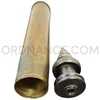
This inert German 37mm round pairs the distinctive Pzgr. 40 armor-piercing composite rigid tracer projectile with a brass case manufactured by DWM in 1936. Its pointed nose, narrow waist, and broad front and rear flanges identify the “arrowhead” design documented in Allied ordnance manuals. The marked case and exposed projectile form make this a useful display and study piece for collectors of German anti-tank ammunition.
Identification and Features
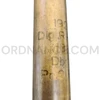
The round belongs to the 37×249mmR ammunition family. Its projectile matches the documented 3.7 cm Pzgr. Patr. 40, while the case carries manufacturer, production, and military acceptance markings.
- P131: Manufacturer code for Deutsche Waffen- und Munitionsfabriken AG, Berlin-Borsigwalde.
- 1936 and 145: Case manufacturing year and lot number.
- 6331: Case design number used for German 3.7 cm Pak ammunition.
- Eagle over WaA270: German military acceptance marking.
- RhS. C/13nA 23/36: Percussion primer with the Rheinmetall/Sömmerda marking and lot 23 of 1936.
- Case stenciling: preserved black markings include Digl.R.P. and the date code 6.39.
Pzgr. 40 Projectile Design
The Pzgr. 40 belonged to Germany’s early-war family of tungsten-core armor-piercing ammunition. Its historical service design carried a hard tungsten-carbide core inside a mild-steel body, with an aluminum-alloy ballistic cap forming the pointed nose. The narrow body reduced weight, allowing a higher muzzle velocity than conventional full-caliber armor-piercing ammunition. The carrier remained with the core during flight, giving this design its “composite rigid” classification. A base tracer helped crews observe the shot’s flight, and the projectile used no bursting charge or fuze. A 1943 U.S. Army reference lists the AP 40 projectile at approximately 12.5 ounces and its muzzle velocity from the 3.7 cm Pak at 3,450 feet per second.
Case and Primer History
The P131 marking belongs to Germany’s prewar system of coded manufacturer identification. The C/13nA percussion primer is for the Pak anti-tank gun application; German 3.7 cm tank-gun ammunition used electric ignition. Surviving loading stencils provide a separate record of the case’s preparation, with 6.39 indicating June 1939. The case and primer dates identify those components.
Pak 36 Development and Service
The 3.7 cm Pak 36, also commonly called the Pak 35/36, grew from German anti-tank gun development during the 1920s and entered service in the 1930s. Its light carriage and low profile suited infantry anti-tank units, and it saw combat during the Spanish Civil War before becoming the German Army’s standard anti-tank gun at the beginning of World War II. Heavier British and French tanks exposed its limitations in 1940, followed by further difficulties against Soviet T-34 tanks. Germany progressively replaced it with the 5 cm Pak 38 and 7.5 cm Pak 40, although the smaller gun remained useful where portability mattered.
Pzgr. 40 in Wartime Use
Pzgr. 40 ammunition increased the Pak’s armor penetration at short range and helped extend the usefulness of existing guns. British official histories document its use with German 37mm anti-tank guns in North Africa during 1941. German ammunition returns show that Pzgr. 40 formed only a limited share of available anti-tank ammunition, and requests for larger supplies were not fully met. This history places the design within Germany’s effort to improve anti-tank performance while more powerful replacement guns reached front-line units.
Condition
All ordnance is inert. Please check the pictures for the general condition of the item.
Ideal For
This round offers several focused collecting and display uses.
- German Pak 36 ammunition collections.
- Museum exhibits on World War II anti-tank developments.
- Comparative study of APCR projectile forms and German ammunition markings.
Approx length 12", Approx width 2", Approx height 2", Approx weight 1.8lbs.
Pictures are stock images of our inventory. Unless otherwise noted, you will not be receiving the exact item shown in the pictures. The pictures are representative of the item’s general condition. The item you receive might be slightly better, or worse, condition than was shown in the pictures.
Please visit our page about order lead times here: Order Lead Times.