




Description
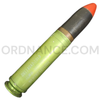
U.S. 30mm XM799 Case with T328 Target-Practice Projectile
Product Overview
This U.S. 30mm display round combines a 30×113B cartridge case marked XM799 with an earlier T328 target-practice projectile. The components belong to separate American ammunition programs. The complete example is an assembled display specimen, rather than an original XM799 high-explosive incendiary cartridge. It brings together two periods of Cold War aircraft armament development in one collectible.
Identification and Features
The case markings identify the later helicopter-ammunition program, while the projectile's driving-band stamps record its earlier model and period.
- 30MM HEI XM799: The cartridge designation originally marked on the case; HEI means High-Explosive Incendiary.
- 28114047-101B: Includes the drawing-number root 28114047, assigned to XM799 in the Army's 1984 ammunition chart.
- 30MM T328: The target-practice projectile designation stamped into the driving band.
- 55: Consistent with 1955 projectile manufacture.
- 30×113B: The case family; B denotes the raised belt around the cartridge case.
Function and Contents
The offered assembly includes the XM799-marked case and fitted T328 projectile. The T328 was designed for target practice in experimental 30mm aircraft-cannon ammunition. Its original Frankford Arsenal drawing shows a separate nose component, rather than an HEI fuze. The red-painted nose on this example does not change the projectile's documented target-practice designation.
Product History
The T328 belongs to American aircraft-cannon development during the 1950s, when engineers were testing new guns and ammunition for faster military aircraft. Frankford Arsenal's drawing identifies it as a target-practice projectile and shows it assembled in the T239 cartridge. That cartridge belonged to the experimental 30×126.5B family, which used a longer case than the 30×113B case present.
XM799 Ammunition Development
The XM799 came from the later Advanced Attack Helicopter ammunition program. Hughes received the development contract in March 1977. The program included the XM788 target-practice cartridge, XM789 high-explosive dual-purpose cartridge, and XM799 high-explosive incendiary cartridge. These designs addressed different training and combat roles within the developing helicopter weapon system. The XM799 printing on this case connects it with the HEI branch of that ammunition effort.
Documented End-Item Applications
The XM799 program was associated with the XM230/M230 chain-gun family. Its development requirements also specified compatibility with the ADEN Mk IV and DEFA 552 and 553 aircraft cannon, and specifically referred to the AV-8A Harrier's ADEN ammunition. Those requirements concern the original ammunition design. The T328 projectile's documented application is separate: T239 target-practice ammunition associated with the experimental T182 aircraft revolver cannon.
Equipment History
The T182 grew from postwar study of the German Mauser MG213 revolver-cannon concept, alongside American development of the 20mm M39. A revolver cannon uses a rotating chamber drum behind a single barrel. Development of the T182 began in 1951 and continued through several versions before work ended in 1957. Changes to its ammunition, including longer cases and revised projectiles, formed an important part of that work.
Weapon System Background
The Army's Advanced Attack Helicopter program led to the AH-64 Apache. Its cannon requirement called for a lightweight weapon suited to a helicopter installation. The Hughes XM230/M230 family used a single barrel and an externally powered chain drive to control the gun's operating cycle. This became the Apache's 30mm cannon armament. Boeing records the first Apache delivery in 1984, placing the later ammunition program within the transition from helicopter development to production.
History of Use
The T182 did not enter operational service, so its ammunition history centers on experimental gun trials. For the later program, contemporary reporting states that XM799 had completed firing tests by November 1979. The Army's 1984 ammunition chart continued to list XM799 under limited procurement. This status documents the ammunition program at that time and does not establish combat use for either component offered here.
Condition
All ordnance is inert. Please check the pictures for the general condition of the item.
Ideal For
This assembled specimen suits collectors studying experimental ammunition, projectile markings, and the development of American aircraft cannon. It offers a useful comparison between early jet-era ammunition and later attack-helicopter cartridge development.
- Cold War experimental-ammunition collections.
- T182 and T239 aircraft-cannon history displays.
- XM799 and XM230 development exhibits.
- Educational displays comparing ammunition components and markings.
Approx length 7.5", Approx width 1.5", Approx height 1.5", Approx weight 1.0lbs.
Please visit our page about order lead times here: Order Lead Times.