





Description
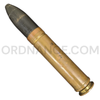
U.S. 30mm T252 Dummy Cartridge with T328 Projectile
Product Overview
Officially designated Cartridge, 30mm, Dummy, T252, this U.S. experimental round is fitted with a T328 projectile. It belongs to the 30×126.5B cartridge family associated with American aircraft cannon development during the 1950s. Its model markings and dated projectile provide a link to that Cold War development program.
Identification and Features
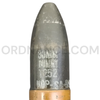
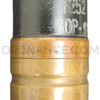
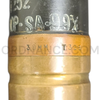
The complete cartridge and its projectile carry separate designations. Additional body and band markings record production information. The KOP and ZEL manufacturer-code associations are listed in MIL-HDBK-1461A.
- 30MM DUMMY T252: Complete dummy-cartridge designation.
- 30MM T328: Projectile designation stamped on the rotating band.
- 55: A 1955 projectile date marked on the band.
- KOP-SA-99X: White marking on the projectile body. KOP is assigned to Kingsbury Ordnance Plant, La Porte, Indiana.
- ZEL-2-4: Stamp on the rotating band. ZEL is assigned to Zeller Corporation, Defiance, Ohio.
Function
The T252 represented an experimental cartridge during non-firing handling and mechanical checks. Dummy ammunition allowed technicians to examine how a round was held and moved by feeding equipment. Its purpose was to provide a representative physical cartridge for this work, supporting development of the gun and its ammunition-handling system.
Product History
The T252 belongs to the longer cartridge stage of the T182 program. During the 1950s, that gun's ammunition evolved through several configurations, including the longer T239 family represented by this dummy. Changes in ammunition requirements brought revisions to the case and projectile, which also affected the gun's design. The T328 projectile's 1955 date fits this period of active experimentation.
Documented End-Item Applications
The primary historical application is the experimental T182 aircraft cannon family. The Defense Intelligence Agency's identification guide, DST-1160G-514-82, Volume 2, lists T252 in its table of experimental American 30mm belted cartridges. It places the round in the 30×126.5B group associated with the T182 and T212 guns. This establishes the broader cartridge-family connection documented for the T252.
Documented Construction
The Air Force ammunition manual describes the T252 with a brass case, steel projectile body, copper rotating band, and aluminum-alloy nose. It specifies a black finish and DUMMY marking. The normal dummy case has neither a primer nor a primer hole. The solid case head on this example matches that documented construction, providing an identifying feature in addition to the model markings.
Equipment History
The T182 gun program began in early 1951 with Oldsmobile. Buffalo Arms later participated, and Ford took on further development in 1954. Changes to ammunition, mounts, and feeding requirements complicated the work and led to revisions of the weapon. Development ceased in 1957, closing a program that had involved several major American manufacturers and several versions of the experimental gun.
Weapon System Background
The T182 grew from postwar study of the German Mauser MG213 revolver cannon principle. Its rotating drum contained five chambers, brought into line with a single barrel. The American 20mm M39 emerged from related work, while the T182 pursued a 30mm weapon. The T182 was originally intended for bomber tail defense, placing its ammunition development within the Air Force's search for new aircraft guns during the early jet age.
History of Use
The T182 program involved limited gun production and repeated development testing. Air Force development histories report that approximately 100 T182 guns were built, but the type never entered service. The T252 dummy design belonged to the handling and mechanical checks that supported this experimental work.
Condition
All ordnance is inert. Please check the pictures for the general condition of the item.
Ideal For
This T252 suits a collection focused on experimental aircraft ammunition, early jet armament, or Cold War weapons development. Its separate cartridge and projectile designations offer useful details for study, while the dated band and production markings add interest for collectors researching ammunition components and their manufacturers.
- U.S. experimental ammunition collections.
- T182 aircraft cannon development exhibits.
- Cold War and early jet aviation displays.
- Collections of inert dummy cartridges and marked projectile components.
Approx length 8", Approx width 1.5", Approx height 1.5", Approx weight 1.0lbs.
Please visit our page about order lead times here: Order Lead Times.