






Description
German 30mm High Explosive Round with ZZ1589B Fuze
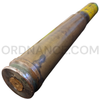
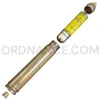
This inert German 30×184mm high explosive round combines a yellow-painted mine-shell projectile, a green identification band, and a marked ZZ1589B nose fuze with a long, belted cartridge case. The fitted C/13nA primer carries a 1938 date. Supplied with its projectile, fuze, case, and primer, this display round gives collectors several distinct German ordnance components to examine alongside the history of Luftwaffe 30mm cannon ammunition.
Identification and Features
The case belongs to the 30×184B ammunition family associated with the MK 101 and MK 103. U.S. ammunition references also list this family as 30×185B. The projectile has a thin body wall, a driving band, and a rounded closed base. These features, together with the surviving “M” stencil, are consistent with a nontracer Minengeschoss, or mine shell.
- Nose fuze marked “ZZ1589B,” with an additional visible “253” stamp.
- Brass primer marked “C/13nA,” “1938,” and “100.”
- Worn case-head numerals include “67” and “44.”
- Original yellow projectile paint, a green band near the nose, and partial black stenciling remain visible.
Mine-Shell Design and Purpose
The Minengeschoss was developed around blast damage to aircraft structures. Its thin steel body left more internal space for an explosive filling than a conventional thick-walled shell. This increased the blast effect while reducing the emphasis on penetration and heavy fragments. German aircraft-ammunition markings used yellow for explosive projectiles and a green ring to identify a self-destruction feature. The “M” marking identified the mine-shell class. These projectiles served a different purpose from the armor-piercing ammunition used by the same cannon family against protected ground targets.
ZZ1589B Fuze and C/13nA Primer
The ZZ1589B was an impact fuze that also provided self-destruction if the projectile missed its target. The June 1944 Luftwaffe ammunition handbook assigns it to MK 108 mine shells; the corresponding fuze listed for MK 103 mine shells is the ZZ1588B. The fitted C/13nA is a percussion primer also documented in German 3.7cm ammunition, including naval C/30 rounds. The components fitted here therefore differ from those documented service combinations. This round is offered as an assembled inert display example, without a claim of original factory matching. The 1938 date belongs to the primer and does not date the complete round.
From the MK 101 to the MK 103
Rheinmetall’s MK 101, also called the MG 101, grew from the Solothurn S-18-1000 20mm antitank-gun design. Enlarged to 30mm for aircraft use, it retained recoil operation and fed from box magazines or drums. Its use in ground attack showed the value of a heavy aircraft cannon but also created demand for greater firepower. Rheinmetall answered with the MK 103, introducing belt feed, electrical primer ignition, and a revised gas-assisted operating system. Its disintegrating-link belt replaced the earlier weapon’s magazine or drum supply, while a muzzle brake reduced recoil shock. These changes improved ammunition supply and increased firepower for aircraft installations.
Aircraft Applications and Wartime Use
The Henschel Hs 129 ground-attack aircraft carried the MK 101 beneath its fuselage on a removable mounting attached to the bomb racks. These installations saw use on the Eastern Front, including tank-hunting missions with armor-piercing ammunition. The later MK 103 also equipped the Hs 129; wartime instructions specifically document its installation on the Hs 129 B-1 and B-2. Another application was the Dornier Do 335 A-1, whose armament included one MK 103 firing through the forward propeller hub with a 70-round supply. Although preproduction Do 335 aircraft reached conversion units before the war ended, the type did not fly combat missions.
Condition
The projectile shows extensive paint chipping, exposed dark metal, pitting, scratches, and worn stenciling. Much of the yellow finish and part of the green band remain. Bright metal is exposed around the lower projectile body and rounded base. The case shows tarnish, scratches, surface discoloration, and patches of corrosion, including green oxidation around the base groove. The fuze has surface wear and remnants of yellow paint. All ordnance is inert. Please check the pictures for the general condition of the item.
Ideal For
The surviving markings and visible components suit collections and exhibits focused on the development and identification of German aircraft ammunition.
- World War II Luftwaffe ammunition collections.
- Comparative study of MK 101, MK 103, and MK 108 components.
- Museum displays explaining mine-shell construction and German fuze markings.
Approx length 12", Approx width 1.25", Approx height 1.25", Approx weight 1.2lbs.
Pictures are stock images of our inventory. Unless otherwise noted, you will not be receiving the exact item shown in the pictures. The pictures are representative of the item’s general condition. The item you receive might be slightly better, or worse, condition than was shown in the pictures.
Please visit our page about order lead times here: Order Lead Times.