




Description
U.S. 3-Inch Common Steel High-Explosive Shell — Base-Fuzed Pattern
Product Overview
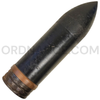
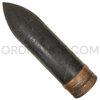
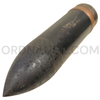
This U.S. 3-inch (76.2 mm) common steel high-explosive shell represents the base-fuzed pattern used with the M1902, M1904, and M1905 field guns. Its pointed nose, single copper driving band, and open threaded base closely match the period illustration. This early 20th-century artillery projectile offers a direct link to the ammunition developed for America’s first generation of modern rapid-fire field guns.
Identification and Features
The body profile and base details agree with the common steel shell described on page 37 and shown in Plate V of the 1917 Ordnance handbook.
- Designation: U.S. 3-inch common steel shell, base-fuzed high-explosive pattern.
- Nominal caliber: 3 inches / 76.2 mm.
- Measured body diameter: 75.58 mm.
- Length: Approximately 11½ inches.
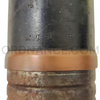
- Construction features: Pointed nose, one copper driving band, and two shallow grooves between the band and base.
- Base configuration: Open threaded fuze cavity surrounded by the base-cover groove; the complete fuze and sealing cover are absent.
Function
The service shell was designed to burst on impact, producing blast and fragments from its steel body. Period artillery texts describe its use against material targets such as guns, walls, and buildings. The copper driving band engaged the gun’s rifling and gave the projectile a stabilizing spin. Its original detonating fuze occupied the base, leaving the pointed nose free of a fuze fitting.
Documented End-Item Application
This ammunition pattern was documented for the U.S. 3-inch field guns M1902, M1904, and M1905. These guns used fixed ammunition, with the projectile secured to a brass cartridge case as one complete round. The historical matching case measured 10.8 inches, or approximately 274 mm, long. That dimension refers to the separate cartridge case and provides context for how the projectile originally formed part of the gun’s ammunition.
Product History
By 1917, the base-fuzed common steel shell had superseded an earlier point-fuzed version in this ammunition family. The Ordnance Department recorded that change in its Handbook of the 3-Inch Gun Materiel, Model of 1902. Revised on June 5, 1917, the handbook provided official information for the Regular Army and National Guard. It documents this shell pattern during the period of America’s entry into the First World War.
Equipment History
The M1902 field gun marked a major step in the U.S. Army’s move from older, slower-firing artillery to modern rapid-fire equipment. The M1904 and M1905 followed as refinements within the same gun family. Their development combined smokeless powder, metallic cartridge cases, improved steel gun construction, and a long-recoil carriage. Together, these changes helped crews handle ammunition more quickly and maintain repeated fire.
Weapon-System Background
These field guns operated within a horse-drawn battery supported by limbers, ammunition caissons, sights, tools, and trained crews. The recoil system allowed the barrel to move backward in its cradle while keeping the carriage largely in position. This reduced the need to reposition the entire gun after each shot. Fixed ammunition supported faster handling, while the battery’s transport equipment kept ammunition and supplies close to the guns.
Base Construction and Cartridge Grooves
The two shallow grooves below the driving band had separate roles: the forward groove supported a waterproof cartridge joint, while the rear groove secured the projectile in its case. The circular groove around the base opening held the original sealing cover. In service, that cover used copper and lead components to keep propellant gases from entering the shell cavity through the fuze joint.
History of Use
The 3-inch gun family equipped American field artillery before World War I. When the United States entered the war, the Army adopted 75 mm equipment for its wartime expansion, and the older 3-inch guns served largely in training and National Guard roles. After the war, surviving guns continued as saluting pieces and displays at military schools and veterans’ organizations. This projectile represents their earlier service-ammunition role.
Condition
All ordnance is inert. Please check the pictures for the general condition of the item.
Ideal For
This common steel shell suits collections and exhibits exploring American artillery development, early high-explosive ammunition, and the equipment used to train field-artillery crews during the First World War era.
- U.S. Army artillery and First World War militaria collections.
- Museum displays on ammunition construction and field-gun development.
- Reference collections of base-fuzed artillery projectiles.
- Historical exhibits associated with the M1902, M1904, and M1905 field guns.
Approx length 11½", Approx width 3", Approx height 3", Approx weight lbs.
Pictures are stock images of our inventory. Unless otherwise noted, you will not be receiving the exact item shown in the pictures. The pictures are representative of the item’s general condition. The item you receive might be slightly better, or worse, condition than was shown in the pictures.
Please visit our page about order lead times here: Order Lead Times.