


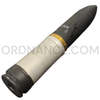


Description
U.S. Experimental 27mm T142 Practice Cartridge
This U.S. experimental T142 practice cartridge represents an early Cold War effort to develop a new aircraft cannon. It belongs to the 27×70B ammunition family associated with General Electric's T150 gun.
Identification and Markings
The caliber, experimental designation, and lot marking identify this cartridge and its manufacturing lineage.
- 27 MM PRACTICE: Identifies the caliber and original practice loading.
- T 142: Identifies the experimental practice-cartridge model.
- LOT WCC-9-4: Records the ammunition lot, including the WCC manufacturer symbol.
- WCC: Identifies the Winchester-Western/Olin
- 27×70B: Cartridge-family designation; the B indicates a belted case, with a raised belt near the base.
Function and Contents
The T142 was practice ammunition for evaluating an experimental gun and cartridge combination. Its original role supported firing trials during development, when engineers needed ammunition to assess a proposed aircraft weapon. The word PRACTICE describes the cartridge's original loading category; it is distinct from a dummy cartridge made solely for handling or mechanical checks.
Product History
The T142 belongs to the early-1950s phase of Project Vulcan, when General Electric explored several ammunition sizes. The program included the .60-caliber T45, 27mm T150, and 20mm T171 guns. Developing ammunition for each option let the military compare possible solutions before choosing a standard aircraft cannon. This cartridge represents the 27mm option within that wider effort.
Documented End-Item Application
The associated weapon was General Electric's T150 experimental 27mm Gatling-type aircraft cannon. T150 identifies the gun, while T142 identifies this practice cartridge. George M. Chinn's Navy-published reference, The Machine Gun, Volume III, places the T150 alongside the related T45 and T171 development weapons and identifies the model C guns as intended for aircraft use.
Equipment History
Chinn's account on printed page 92 describes a 1952 development plan that called for five conversion kits for the 27mm T150. It also lists six kits for the .60-caliber T45 alongside the 20mm T171 guns scheduled for delivery beginning that August. These conversion plans show how the program used related gun equipment to study different calibers.
Weapon-System Background
Project Vulcan brought the Gatling principle into the jet age. An external power source drove a rotating group of barrels, spreading firing heat across several barrels and supporting rapid fire during brief engagements. The successful 20mm branch continued through the T171 series. In 1956, the U.S. Air Force and Army standardized that development as the M61 Vulcan aircraft gun, establishing the program's lasting service legacy.
History of Use
The 27mm program's documented role was experimental aircraft-armament development. The Air Force report The History of the Aerial Gatling Gun, printed page 11, records that the T150 existed for only a short period before General Electric dropped the design. The T142 therefore belongs to the testing stage of this history. Its connection to the later M61 is through Project Vulcan's development lineage.
Condition
All ordnance is inert. Please check the pictures for the general condition of the item.
Ideal For
This cartridge adds a documented experimental designation to a collection focused on the choices behind American aircraft-gun development.
- Experimental ammunition and Cold War ordnance collections.
- Displays tracing Project Vulcan and the origins of the M61.
- Reference collections of Winchester-Western/Olin military production.
- Educational exhibits about aircraft-cannon caliber trials.
Approx length 6.5", Approx width 1", Approx height 1", Approx weight 0.6lbs.
Please visit our page about order lead times here: Order Lead Times.