


Description
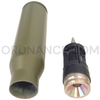
25mm M791 Armor-Piercing Discarding-Sabot-Tracer Round without Sabot Windscreen
Item Overview
This 25mm M791 Armor-Piercing Discarding-Sabot-Tracer round is missing the sabot windscreen. The M791 was the primary armor-piercing service cartridge developed for the M242 Bushmaster 25mm automatic cannon. Its high-velocity, subcaliber penetrator was designed to defeat lightly armored vehicles and other protected targets.
Identification and Features
Official designation: Cartridge, 25mm, Armor-Piercing Discarding-Sabot-Tracer, M791
Abbreviation: APDS-T
Caliber: 25×137mm
DODAC: 1305-A974
Standard penetrator: Solid tungsten alloy
Sabot: Molded nylon, discarding type
Standard windscreen: Aluminum, missing from this example
Original tracer: Pressed-in tracer pellets
Explosive projectile filling: None
Fuze: None
Weapon application: M242 25mm automatic cannon
Missing Windscreen
The standard M791 projectile used a plastic sabot windscreen. This example is missing that component, leaving the forward portion of the projectile assembly exposed. It is incomplete compared with a standard service round, but the missing windscreen provides a clearer view of the construction normally hidden beneath it.
How It Worked
The M791 placed a narrow tungsten-alloy penetrator inside a lightweight sabot that matched the gun’s 25mm bore. When fired, the sabot transferred pressure and spin to the penetrator while guiding it through the barrel. After muzzle exit, the sabot sections separated and fell away while the smaller penetrator continued toward the target at high velocity. Armor penetration came from concentrated kinetic energy rather than an explosive charge.
Standard Performance
A complete standard M791 measured approximately 223mm long and weighed about 454 grams. Its projectile weighed approximately 134 grams, including a 102-gram penetrator, and had a listed muzzle velocity of about 1,345 meters per second. These figures describe a complete service cartridge; the listed example may differ because its windscreen is missing.
Historical Background
The M791 entered service with the M242 Bushmaster cannon during the early 1980s. The M242 became the primary armament of the U.S. Army’s M2 and M3 Bradley vehicles and was also used with platforms such as the Marine Corps LAV-25 and Navy Mk 38 gun mount. The M791 provided these systems with armor-piercing capability against lightly armored vehicles, self-propelled artillery, and similar targets. It was later replaced as the standard U.S. armor-piercing service cartridge by the improved M919 APFSDS-T.
Ideal For
This M791 is well suited for 25mm ammunition collections, M242 Bushmaster displays, sectioned-projectile exhibits, Bradley and LAV-25 displays, military museums, and ordnance identification study.
Approx length 9", Approx width 1.5", Approx height 1.5", Approx weight 0.9 lbs.
Pictures are stock images of our inventory. Unless otherwise noted, you will not be receiving the exact item shown in the pictures. The pictures are representative of the item’s general condition. The item you receive might be slightly better, or worse, condition than was shown in the pictures.
Please visit our page about order lead times here: Order Lead Times.