



Description
Japanese 25mm HE-T Round for the Type 96 Antiaircraft Cannon
Japanese 25×163mm high-explosive tracer (HE-T) round with a steel projectile, Type 4 nose fuze, and brass cartridge case. This inert round represents ammunition used by the Imperial Japanese Navy’s Type 96 automatic cannon during World War II. Its separate projectile, fuze, and case provide a useful display for collectors of Japanese naval ordnance and Pacific War artifacts.
High-Explosive Tracer Projectile
The steel HE-T projectile has two copper driving bands: a broad forward band with a circumferential groove forming two bearing surfaces, and a separate narrow band near the base. Its threaded nose receives the fuze. In service, the forward cavity held the explosive filling, while a separate cavity in the base carried the tracer. This arrangement combined blast and fragmentation with a visible flight path that helped gunners observe and correct their fire. HE-T formed part of a wider ammunition family that also included high-explosive, incendiary, and armor-piercing loadings for the Type 96.
Type 4 Nose Fuze
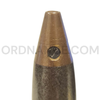
The Type 4 (1944) nose fuze, also called Model 4 in U.S. ordnance manuals, was designed to initiate the shell on impact. It has a two-piece brass body, tapered nose, and slotted lateral closing screw. Developed from the earlier Type 1 (1941), the Type 4 simplified the internal assembly and reduced the space occupied inside the projectile. This change allowed a slightly larger explosive filling in service projectiles fitted with the later fuze.
Brass Case and Primer
The 163mm drawn-brass case has a bottleneck profile, rimless head, and deep extractor groove. Its long neck surrounds the projectile’s rear band; service rounds were secured by crimping the case around this band. The base retains the central primer and its larger circular body. The service primer design used a press-fit brass body with a Boxer-type percussion cap. Together, the case and projectile formed the fixed round used in the Type 96’s magazine feed system.
Hotchkiss Origins and Type 96 Development
The Type 96 developed from the French Hotchkiss 25mm automatic gun. In 1935, the Japanese Navy selected the design to replace its unsatisfactory 40mm Vickers guns. Trials at Yokosuka Naval Arsenal were followed by domestic production, with quantity shipboard installations beginning in 1936 using twin mounts. Japanese changes included cast components, improved flash suppressors, and powered control for some multiple mounts. Triple-mount design was completed in 1941, followed by single-mount design in 1943.
Naval and Shore Service
The Type 96 became a principal light antiaircraft weapon of the Imperial Japanese Navy. Installations included the battleships Yamato and Musashi, the aircraft carriers Shokaku and Zuikaku, and numerous cruisers and destroyers. Shore installations defended airfields and naval bases. The gun was gas-operated and air-cooled, with ammunition fed from 15-round magazines. Its standard cyclic rate was approximately 220 rounds per minute per gun, but frequent magazine changes reduced practical output to about 110 rounds per minute.
Condition
All ordnance is inert. Please check the pictures for the general condition of the item.
Ideal For
This round offers several useful applications for collectors and historical displays.
- Imperial Japanese Navy and Pacific War ordnance collections.
- Museum exhibits explaining Type 96 antiaircraft armament.
- Comparative study of Japanese projectiles, fuzes, and cartridge cases.
Approx length 9.5", Approx width 1.75", Approx height 1.75", Approx weight lbs.
Pictures are stock images of our inventory. Unless otherwise noted, you will not be receiving the exact item shown in the pictures. The pictures are representative of the item’s general condition. The item you receive might be slightly better, or worse, condition than was shown in the pictures.
Please visit our page about order lead times here: Order Lead Times.