





Description
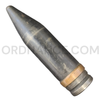
1952 U.S. 20mm M99 Target-Practice Projectile
Product Overview
This U.S. 20mm M99 target-practice projectile is dated 1952 and belongs to the Hispano aircraft-cannon ammunition family. It represents early Cold War production of a training design developed during World War II. Its caliber, TP designation, year, lot information, and manufacturer's code provide several useful details for collectors studying Korean War-era aviation ordnance.
Identification and Features
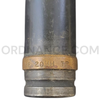
The combination of a two-digit year, lot reference, and maker's code reflects the way military production was tracked. The visible inscriptions identify the following details.
- 20MM: Nominal 20mm caliber.
- TP: Target Practice.
- 52: Manufacture year, 1952.
- 6-3: Production lot information.
- PMC: Manufacturer's identifying code.
Function
The M99 was designed for practice firing in aircraft cannon. Its original projectile design contained no explosive filling and required no fuze. When fired as part of a service training cartridge, its effect on a target came from impact and penetration. This allowed aircrews to practice gunnery with ammunition developed specifically for range firing.
Product History
The M99 developed from the wartime T24 practice cartridge. The Army's June 1944 ammunition manual identified it as T24 (M99), placing the design firmly within World War II development. By 1947, Navy references described the M99 as replacing the older Ball Mk I round. This example's 1952 manufacture date carries that design history into the early Cold War, when established wartime weapons and ammunition remained important to military aviation.
Documented End-Item Applications
Wartime Army references list the T24 (M99) practice cartridge for the 20mm M1, AN-M2, M3, and British Hispano aircraft guns. Historical complete cartridges used the M21A1 case in the 20×110mm Hispano ammunition family. The December 1957 aircraft-ammunition manual continued to list the M99 for the M3 cannon and an electrically primed M99 cartridge for the M24A1. These are documented ammunition applications; the item offered here is the projectile component.
Equipment History
The M1 and AN-M2 formed part of American aircraft-cannon armament during World War II. The Army's 1943 gun manual described air-cooled automatic weapons intended for wing, fuselage, or turret installations, using drum magazines or linked ammunition according to the equipment fitted. The related M3 continued in postwar service. The Navy's 1956 gun catalog still listed it as an aircraft weapon for fixed or flexible mountings, showing the continued role of this cannon family during the jet age.
Weapon-System Background
The M99 was the practice member of a ballistically matched group of 20mm aircraft ammunition. Other members included the M95 armor-piercing tracer, M96 incendiary, and M97 high-explosive incendiary types. Their shapes, lengths, and weights were designed to produce broadly similar flight behavior. Army descriptions specifically compared the M99's shape and ballistic properties with the M96. This relationship made practice ammunition part of the same overall gunnery system as the service rounds.
History of Use
The M99's documented role was practice firing as aircraft-cannon use continued beyond World War II. During the Korean War, naval aircraft such as the F9F Panther carried four forward-firing 20mm cannons. The Panther first entered combat on July 3, 1950, flying from USS Valley Forge, and served extensively with Navy and Marine Corps squadrons. This projectile represents the training-ammunition side of that period's aircraft-armament history.
Condition
All ordnance is inert. Please check the pictures for the general condition of the item.
Ideal For
This dated M99 suits a collection focused on American aircraft ammunition and its development from World War II into the Cold War. Its model, year, and lot reference provide concrete points for comparison with period illustrations and other marked examples.
- U.S. 20mm projectile collections.
- Korean War-era aviation ordnance displays.
- Hispano aircraft-cannon history studies.
- Military ammunition marking and production-lot research.
Approx length 3", Approx width 0.75", Approx height 0.75", Approx weight 0.3lbs.
Please visit our page about order lead times here: Order Lead Times.