


Description
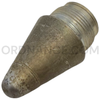
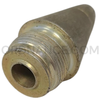
U.S. M505A3 Point-Detonating Nose Fuze for 20mm Cannon Ammunition
Product Overview
This U.S. M505A3 point-detonating nose fuze belongs to the M505 series used with 20mm cannon projectiles. Its documented applications include high-explosive incendiary ammunition for aircraft guns and ground-based air-defense weapons. As a separate display component, it represents a compact part of the ammunition systems that served American forces during the Cold War and later decades.
Identification and Features
M505A3 identifies the fuze model within the broader M505 family. Army's November 1969 engineering handbook list the fuze separately from the projectile and complete cartridge, each of which has its own designation.
- Model: M505A3.
- Family: U.S. M505-series cannon fuzes.
- Type: Mechanical point-detonating, or PD, nose fuze.
- Documented ammunition role: Selected 20mm high-explosive incendiary and high-explosive incendiary-tracer cartridges.
Function
In its original service role, the M505A3 initiated the projectile's main explosive filling when the nose struck a target. “Point-detonating” describes this impact function at the front of the projectile. The fuze provided the initiating action, while the projectile carried the main filling. Army ammunition data describes its intended targets as aircraft and lightly armored materiel.
Product History
The M505A3 was an established design by the late 1960s. The Army's November 1969 engineering handbook illustrated it as an example of a compact 20mm cannon fuze. A revised military specification for its metal parts followed in October 1976, replacing a May 1971 edition. These records trace the design through successive military production standards. It remained listed as standard in later Army ammunition.
Documented End-Item Applications
Army references identify the M505A3 with the M56A3 and M56A4 high-explosive incendiary cartridges, along with the M97A2, M210, M242, and M246 types. These applications reach across the 20×102mm Vulcan and 20×110mm Hispano ammunition families. The corresponding ammunition served guns including the M39, M61, M168, M3, and M24A1, depending on the cartridge. This application history ties the fuze to several weapon systems through their specified ammunition.
Equipment History
The M61 Vulcan is a major part of this fuze's parent-equipment history. Entering service in the 1950s, the cannon used six rotating barrels based on the Gatling principle. Sharing the firing load among several barrels helped manage heat and barrel wear. Vulcan installations armed aircraft including the F-104 Starfighter, F-105 Thunderchief, and F-4E Phantom II, followed by later fighters such as the F-15 and F-16.
Weapon-System Background
In its Vulcan-family applications, the M505A3 formed part of the M50-series ammunition system. That series provided different cartridge types for service firing, target practice, testing, and handling drills. Navy training publications describe matched ballistic characteristics across service types, allowing a common gun system to support several ammunition roles. The M505A3 belonged to the explosive-projectile side of that system, including HEI and HEI-tracer rounds.
History of Use
The Army's January 1970 Research and Development news magazine reported multiple procurement awards for M505A3 fuzes during the Vietnam War. This provides direct evidence of production orders in that period. Decades later, the Navy's July 2001 Aviation Ordnanceman course still described the M505A3 as a component of aircraft-cannon ammunition. Together, these records connect the model with both wartime ammunition supply and the technical training of ordnance personnel over several decades.
Condition
All ordnance is inert. Please check the pictures for the general condition of the item.
Ideal For
This fuze suits a collection focused on American cannon ammunition and the smaller components behind complete service rounds. Its documented use across more than one cartridge family also makes it useful for exhibits that explain the relationship between fuzes, projectiles, ammunition types, and their parent weapons.
- U.S. military fuze and ammunition collections.
- Cold War aviation ordnance displays.
- 20mm Vulcan and Hispano ammunition studies.
- Educational exhibits about cannon-projectile components.
Approx length 1", Approx width 0.5", Approx height 0.5", Approx weight 0.1lbs.
Please visit our page about order lead times here: Order Lead Times.