



Description
U.S. Military 20mm M24/M24E2 Driving Spring Guide Retainer, Drawing 7229624
Item Overview
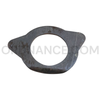
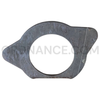
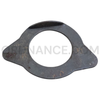
This U.S. military Retainer, Driving Spring Guide is a formed stamped-steel locking plate used in the driving-spring and rear-buffer group of the 20mm M24 and M24E2 aircraft automatic guns. The retainer locks the driving-spring guide plunger to the rear-buffer assembly, helping keep these parts properly secured during the gun’s firing cycle. It is a purpose-built cannon component rather than an ordinary washer. This listing is for one retainer identified by drawing number 7229624, Revision 1, and military stock number J941-R-3891-200.
Identification and Features
The supplied identification data names this component as “Retainer, Driving Spring Guide.” Its formed profile matches the guide-retainer pattern shown in the M24/M24E2 driving-spring group in TM 9-2006. The M24A1 used a revised two-spring arrangement with a different guide-group layout, while this retainer belongs to the single-driving-spring configuration illustrated for the M24 and M24E2.
- Official nomenclature: Retainer, Driving Spring Guide
- Stock number: J941-R-3891-200
- Drawing number: 7229624, Revision 1
- Manufacturer number: A.S.C.-A-25,000-P1
- Contract number: DA-30-144-ORD-1199
- Quantity: One retainer
- Construction: Formed stamped steel
- Application: 20mm M24 and M24E2 aircraft automatic guns
Function and Operation
The M24/M24E2 driving-spring guide passes through the rear buffer and enters the gun’s bolt assembly. During firing, rearward movement of the breechblock compresses the driving spring while the rear buffer absorbs the remaining recoil force. The compressed springs then help drive the breechblock forward to chamber the next round. When installed, the flange of this retainer engages a flat surface on the rear buffer, and sections of the plate are bent against flats on the guide plunger. This locks the threaded guide connection in place so it will not loosen during repeated cycling. The rear buffer and springs manage the recoil force, while the retainer keeps their connection secure.
End-Item Application
The M24 and M24E2 were air-cooled 20mm aircraft automatic guns that combined gas operation with blowback action and fired electrically primed fixed ammunition. They could be mounted as fixed guns in an aircraft wing or fuselage or installed in flexible aircraft turrets. The guns could be arranged for right-hand or left-hand ammunition feed and had a normal cyclic rate of approximately 700 to 800 rounds per minute, although some installations controlled the rate at a lower level. TM 9-2006, Figure 10, places the formed guide retainer between the driving spring and rear-buffer assembly in the M24/M24E2 single-spring configuration.
Historical Background
The M24 came from the American line of 20mm aircraft cannon developed from the Hispano-Suiza Birkigt Type 404 design. During World War II, the U.S. Ordnance Department developed the lighter T31 aircraft gun. The rear-seared T31 became the 20mm M3, while the forward-seared T31E2 used electric ignition and was selected for development as the M24. Electric priming allowed the firing of paired guns to be controlled and synchronized for remotely operated bomber turrets. The T31E2 was made substitute standard in November 1947 and officially designated the M24. M24 guns modified with a chamber plunger and altered bolt for the B-36 installation became the M24E2. Continued development produced the M24A1 with improved extraction parts, a stronger receiver, an improved gas system, and a two-piece driving spring. This retainer belongs to the earlier single-spring M24/M24E2 driving-spring group.
History of Use
The M24 and M24E2 served as defensive armament aboard the Convair B-36 Peacemaker. Early B-36 bombers carried six remotely controlled retractable turrets of the type equipped with two M24 20mm cannon. These paired guns gave the large aircraft concentrated defensive fire against attacking fighters. Deliveries of the B-36 to Strategic Air Command began in 1948, and the bomber’s intercontinental range and nuclear capability made it an important part of American deterrence during the opening years of the Cold War. During operation, retainers of this pattern secured the driving-spring guide to the rear buffer as the cannon cycled under recoil.
Condition
This is a military-surplus stamped-steel component offered in a quantity of one. Identification is based on the supplied military stock, drawing, manufacturer, and contract information. The formed locking flange and tabs distinguish it from a standard flat washer. Individual examples may show storage marks, finish variation, or age-related surface wear consistent with surplus parts. Only the driving-spring guide retainer is included.
Ideal For
This documented component is suited to collections and displays centered on U.S. aircraft armament, the M24/M24E2 cannon family, Convair B-36 defensive equipment, and early Cold War military aviation. Its military stock number, drawing number, manufacturer number, and contract information also make it a useful reference piece for parts identification and manual-based ordnance study.
- M24 and M24E2 cannon displays
- B-36 Peacemaker armament collections
- Early Cold War aviation exhibits
- Aircraft-cannon component identification
- Military technical and manufacturing studies
Approx length ", Approx width ", Approx height ", Approx weight lbs.
Pictures are stock images of our inventory. Unless otherwise noted, you will not be receiving the exact item shown in the pictures. The pictures are representative of the item’s general condition. The item you receive might be slightly better, or worse, condition than was shown in the pictures.
Please visit our page about order lead times here: Order Lead Times.