


Description
Inert 20mm High-Explosive Incendiary Tracer Round with M21A1 Case
Item Overview
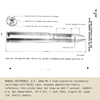
This inert 20mm High-Explosive Incendiary Tracer (HEI-T) display round is assembled with an M21A1 brass cartridge case. The M21A1 belongs to the 20×110mm Hispano ammunition family used with American and British 20mm aircraft cannon. The complete display shows how a projectile and cartridge case appeared as one fixed round. It contains no functioning explosive, incendiary, tracer, primer, or propelling components and is intended only for collecting, study, and display.
Identification and Features
M21A1 is the military designation for the cartridge case, not the projectile. Wartime technical manuals identify it as the standard brass case for U.S. 20mm M1 and AN-M2 cannon ammunition, while the M21A1B1 was a steel substitute. HEI-T describes a projectile that originally combined high-explosive, incendiary, and tracer effects. Period manuals for the M21A1 case list several loads, including high-explosive incendiary, armor-piercing tracer, incendiary, ball, and practice ammunition, but the case marking alone cannot prove which projectile was originally loaded in it. No exact projectile model, fuze model, maker, date, or original factory pairing is claimed unless it is visible in the inventory photographs.
- Caliber: 20mm
- Projectile type: High-Explosive Incendiary Tracer (HEI-T)
- Cartridge case: M21A1
- Case material: Brass
- Ammunition family: 20×110mm Hispano
- Configuration: One confirmed inert display round
- Status: No functioning explosive, incendiary, tracer, primer, or propelling components
Original Service Function
A live HEI-T projectile combined three effects in one round. Its high-explosive charge was intended to burst the projectile and produce fragments when the projectile functioned. Its incendiary material added a fire-starting effect against suitable aircraft, equipment, fuel, or other light targets. A tracer in the rear produced a visible path during flight, allowing the gunner to observe the stream of fire and make corrections. The cartridge case held the primer and propelling charge and sealed the gun chamber during firing. After the round fired, the weapon extracted and ejected the empty case as the next cartridge moved into position. This description explains the historical function of live ammunition only; the offered example cannot perform any of these functions.
Ammunition and Weapon Applications
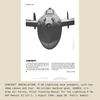
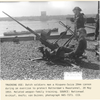
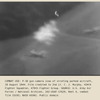
The M21A1 case was made for the 20mm M1 and AN-M2 automatic cannon and related British Hispano-Suiza aircraft cannon chambered for the same ammunition family. These gas-operated cannon could be installed in aircraft wings, fuselages, or other fixed mounts, and compatible ammunition could be supplied in disintegrating-link belts or drum magazines. A well-known American application was the Lockheed P-38 Lightning, which carried one 20mm cannon with four .50-caliber machine guns in its nose. Concentrating the guns in the nose gave the P-38 a tight pattern of forward fire without the aiming limits caused by widely spaced wing guns. These weapon and aircraft references explain the history of the M21A1 case family and do not establish the service history of this individual inert round.
Historical Background
The 20mm Hispano cannon family developed from the Hispano-Suiza Type 404 created in Europe during the 1930s. Its combination of aircraft-ready size, automatic fire, and a larger projectile than a machine gun made it useful against aircraft and light ground targets. The United States tested the design before World War II and adopted American versions as the M1 and later M2, which became the AN-M2 under the joint Army-Navy designation system. Wartime manuals describe the M21A1 as the standard brass case and the M21A1B1 as a steel substitute used to conserve brass. The P-38E introduced a 20mm cannon to the Lightning production line in 1941, and later P-38 variants served in Europe, North Africa, and the Pacific. Their missions included fighter combat, bomber escort, reconnaissance support, and attacks on ground targets. M21A1-cased ammunition belongs to this larger history of Allied aircraft armament, even though the exact origin and use of this assembled inert example are unknown.
Condition
This listing is for one confirmed inert 20mm display round with an HEI-T-type projectile and an M21A1 brass case. Surplus components may show scratches, dents, tarnish, oxidation, discoloration, finish loss, handling marks, or other signs of age and storage. Headstamps, paint, sealant, markings, projectile details, and the method used to render the item inert may vary between examples. The projectile and case may have been assembled for display and are not represented as an original factory-loaded combination. Historical reference images show the ammunition family and associated weapon use; they do not show the exact inventory item. Please check the stock pictures for the general condition of the round offered.
Ideal For
This inert round is well suited for collections and exhibits covering 20mm aircraft ammunition, Hispano cannon development, World War II aviation, and the history of American aerial armament. Its assembled form provides a clear visual example of the relationship between a projectile and cartridge case. It can also complement displays devoted to the M1 or AN-M2 cannon, the P-38 Lightning, military ammunition identification, or inert ordnance technology.
- 20mm ammunition collections
- Hispano cannon displays
- M1 and AN-M2 cannon exhibits
- P-38 Lightning armament displays
- World War II aviation collections
- Military museums and educational exhibits
Approx length 7", Approx width 1", Approx height 1", Approx weight 0.6lbs.
Pictures are stock images of our inventory. Unless otherwise noted, you will not be receiving the exact item shown in the pictures. The pictures are representative of the item’s general condition. The item you receive might be slightly better, or worse, condition than was shown in the pictures.
Please visit our page about order lead times here: Order Lead Times.