




Description
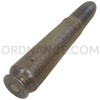
German WWII 20mm Armor-Piercing Incendiary Round for the MG FF/M Aircraft Cannon
This German 20mm round features a 1942-dated projectile and 1943-dated steel case, both bearing the manufacturer code wg. Its pointed internal capsule, threaded base plug, and 115g projectile marking support identification as the phosphorus armor-piercing incendiary loading for the MG FF/M aircraft cannon. Offered inert for collection and display, it provides a detailed example of German aircraft ammunition with visible wartime production markings and separate internal components.
Armor-Piercing Body and Internal Capsule
The projectile has a pointed steel body, a metal driving band, and a threaded base closure. The lightweight, aluminum-type internal piece is the aluminum incendiary capsule documented for this loading. In service, the hardened outer body provided armor penetration, while the capsule carried the incendiary material. The Projectile has the capsule, a separate brown fiber disc, and the removable base plug. This construction is the German 2 cm Panzerbrandgranatpatrone (Phosphor) FFM o. Zerl., a phosphorus armor-piercing incendiary round.
Incendiary Function and Service Loading
The phosphorus loading combined penetration with an incendiary effect when impact broke the projectile and released its contents into the target. The German ammunition manual documents this type on a sheet dated October 1942, listing a 115-gram projectile and a muzzle velocity of 585 meters per second from the MG FF/M. Its intended roles included air combat against armored aircraft and attacks on suitable ground targets. This service loading used no fuze, tracer, or self-destruct device; the threaded rear component is a base plug. These figures describe the historical service round, not the measured weight or performance of this inert example.
HASAG Production Markings
The projectile is stamped “wg 38k 42 115g.” The code wg identifies HASAG, Hugo Schneider AG, Altenburg plant; 38k is a production marking, 42 indicates 1942, and 115g records the designated projectile weight. The case head carries “wg,” “9d,” and “43,” identifying the same manufacturer and a 1943 case date. A Luftwaffe acceptance mark containing 54 is also visible, with a similar stamp on the projectile’s driving band. The two dates belong to the individual components and do not establish an original matching assembly.
Steel Case and MG FF/M Ammunition
The round uses the short steel case associated with the 20×80mm cartridge, commonly cataloged as 20×80RB. Its reduced-diameter rim and nearly straight case body distinguish this ammunition from the 20×82mm cartridge used by the MG 151/20. German documentation specifies a lacquered steel case and a G 2 percussion primer for the phosphorus MG FF/M loading. Although related projectile designs appeared in more than one German 20mm ammunition series, the complete cartridges were specific to their respective guns.
From Oerlikon FF to MG FF/M
The MG FF’s ancestry runs through the Swiss Oerlikon FF to the earlier Becker automatic cannon system. During the 1930s, Ikaria in Berlin developed and manufactured the German MG FF under license, using a more powerful cartridge than the original Oerlikon FF. The gun employed advanced primer ignition blowback operation and drum feeding. In 1940, the modified MG FF/M appeared to accommodate Minengeschoß ammunition, whose lighter projectile carried a comparatively large explosive charge. The modified weapon also used armor-piercing, incendiary, and other service loadings, including the phosphorus type represented here.
Luftwaffe Aircraft Applications
The MG FF/M armed aircraft including the Messerschmitt Bf 109 E-4 and members of the Bf 110 series. The Bf 109 E-4 carried two wing-mounted MG FF/M cannon alongside two fuselage-mounted MG 17 machine guns. The cannon’s firing rate was approximately 530 rounds per minute, but its usual 60-round drum limited the ammunition available in wing installations, where drums could not be changed during flight. The later belt-fed MG 151/20 addressed this limitation and progressively replaced the MG FF/M in many aircraft installations.
Condition
All ordnance is inert. The projectile retains a dark finish with visible scratches, surface wear, and exposed metal around the driving band. The steel case shows brown oxidation, spotting, discoloration, and edge wear. The photographs show the case, projectile body, internal capsule, fiber disc, and threaded base plug separately. Please check the pictures for the general condition of the item.
Ideal For
The marked components and visible internal construction suit collections examining German aircraft ammunition and its manufacture.
- World War II Luftwaffe ammunition collections.
- MG FF/M, Bf 109 E-4, and Bf 110 armament displays.
- Study of HASAG production codes and ammunition acceptance markings.
- Comparisons of armor-piercing, incendiary, and high-explosive aircraft projectiles.
Approx length 6", Approx width 1", Approx height 1", Approx weight 0.6lbs.
Pictures are stock images of our inventory. Unless otherwise noted, you will not be receiving the exact item shown in the pictures. The pictures are representative of the item’s general condition. The item you receive might be slightly better, or worse, condition than was shown in the pictures.
Please visit our page about order lead times here: Order Lead Times.