



Description
20mm German WWII High Explosive Incendiary Tracer Round for the MG 151/20 Aircraft Cannon
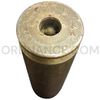
This German 20mm round combines a 1944-dated HASAG case with a projectile marked W4b39 and an AZ 1528 A fuze body. It belongs to the 20×82mm ammunition family used by the Mauser MG 151/20 aircraft cannon. Offered inert for collection and display, it retains original paint remnants and component markings that make it useful for studying German aircraft ammunition identification.
HASAG Case and Headstamp
The rimless bottleneck case carries the headstamp wb 167 44. The manufacturer code “wb” identifies Hugo Schneider AG, commonly known as HASAG, at Berlin-Köpenick. The remaining markings indicate case lot 167 and manufacture in 1944. MG 151/20 ammunition existed with both percussion and electrical ignition; this round has an empty primer pocket, with the central anvil visible.
Projectile Colors and W4b39 Marking
The steel projectile retains faint yellow paint, a red band immediately above the copper driving band, and remnants of a wide blue band below the fuze. The stamp W4b39 appears in the red-painted area. In contemporary German aircraft ammunition identification, yellow indicated a high-explosive projectile, a blue band indicated an added incendiary effect, and a red band indicated tracer. That service ammunition combined explosive and incendiary effects against aircraft with a tracer that helped the pilot observe the path of fire.
Development of the MG 151/20
Mauser developed the MG 151 as a 15mm aircraft weapon during the 1930s. The 20mm MG 151/20 followed in 1941, providing a larger projectile for explosive aircraft ammunition. It retained the family’s belt-fed, recoil-operated design and locked breech. Belt feeding supported larger ammunition supplies than the 60-round drums commonly used with the earlier MG FF, which the MG 151/20 increasingly replaced in German fighter armament. The original German weapon handbook gives a firing rate of approximately 700 rounds per minute and describes both fixed and movable aircraft installations.
Bf 109 and Fw 190 Fighter Armament
The Messerschmitt Bf 109 F-4 provides a documented example of the change to 20mm armament: the preceding F-2 carried a 15mm cannon, while the F-4 carried a 20mm MG 151 between the engine’s cylinder banks, firing through the hollow propeller shaft. Its belt supply held approximately 200 rounds, supplementing two rifle-caliber machine guns. The Focke-Wulf Fw 190 D-9 used two MG 151/20 cannon in its wings, with 250 rounds per gun, alongside two 13mm MG 131 machine guns above the engine. These installations illustrate the gun family’s role in Luftwaffe fighter armament.
Ground and Postwar Service
The MG 151 family also served in ground antiaircraft mounts. The Sd.Kfz. 251/21 half-track carried three MG 151 weapons, with installations documented in both 15mm and 20mm. After World War II, France used recovered MG 151/20 cannon in helicopter armament. French records document H-34 installations during the Algerian War in 1957–1959 and later adaptation to the Alouette III. The French 20mm AME 621 subsequently replaced the MG 151 in this role, extending the weapon’s development story well beyond its original Luftwaffe service.
Condition
All ordnance is inert. This example shows extensive paint loss, exposed metal, oxidation, discoloration, and surface wear. Dents are visible around the case neck and shoulder. The projectile is removable from the case, the primer is absent, and the fuze body has an open nose with components missing. Please check the pictures for the general condition of the item.
Ideal For
The marked case, surviving color bands, and identified fuze body provide several useful points of comparison for collections and educational displays.
- World War II Luftwaffe ammunition collections.
- MG 151/20, Bf 109 F-4, and Fw 190 D-9 armament displays.
- Research into German projectile colors, fuze designations, and manufacturer codes.
- Museum exhibits tracing aircraft cannon development and later service.
Approx length 5.75", Approx width 1", Approx height 1", Approx weight 0.4lbs.
Pictures are stock images of our inventory. Unless otherwise noted, you will not be receiving the exact item shown in the pictures. The pictures are representative of the item’s general condition. The item you receive might be slightly better, or worse, condition than was shown in the pictures.
Please visit our page about order lead times here: Order Lead Times.