




Description
German 20mm High-Explosive Tracer Round with 1502F Fuze
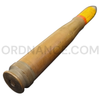
This German 20mm high-explosive tracer (HE-T) round features a 1937-dated Silva Metallwerke case and a 1943-dated 2cm Kpf.Z.1502F nose fuze. The projectile retains yellow paint, a red tracer identification band, and stamped production markings, offering several points of interest for collectors of German cannon ammunition.
Identification & Features
The 20x138mm cartridge commonly cataloged as 20x138B or 2cm Long Solothurn. The yellow projectile body, remaining black markings, and red band above the driving band are German high-explosive tracer ammunition. The red band identifies the tracer color.
- Projectile: Steel body with yellow paint, a red-orange identification band, and a copper-colored driving band. The stamped production line reads “P75 21A37.”
- Nose fuze: Marked “2cm KPF.Z.1502F,” with separate “1943” and “610” stamps.
- Case: Headstamped “P345,” “37,” and “2n,” with a military acceptance mark. P345 identifies Silva Metallwerke GmbH of Genthin, Germany; “37” dates the case to 1937.
- Component dates: The case and fuze carry different manufacturing dates.
Projectile Role and Fuze Development
German high-explosive tracer ammunition combined a fragmentation effect with a visible trace that helped crews observe the projectile’s flight. It served against aircraft and suitable ground targets, while armor-piercing ammunition filled a separate role. The aluminum-bodied 1502F was an impact nose fuze, also recorded as A.Z.1502F in Allied technical references. It developed from the earlier A.Z.1502, retaining the same basic purpose while changing the internal arming arrangement.
Cartridge Development
Solothurn developed the 20x138B cartridge during the 1930s as an improvement over its earlier 20x105B ammunition. The larger cartridge became an important European 20mm ammunition type, used in anti-aircraft guns, anti-tank weapons, and vehicle armament. German production included high-explosive tracer, armor-piercing, practice, and other specialized loadings. Cases were manufactured in both brass and steel. This example’s P345 headstamp identifies Silva Metallwerke as the case manufacturer, while its 1937 date places that component in the prewar expansion of German ammunition production.
Flak 38 and Related Applications
Period ammunition references associate 1502F-equipped rounds with the model 38 anti-aircraft and tank guns, including the 2cm Flak 38 and 2cm KwK 38. The four-barrel Flakvierling 38 used four Flak 38 guns on a common mounting. Mauser developed the Flak 38 as an improvement to Rheinmetall’s Flak 30, responding to the need for a higher firing rate highlighted by experience in the Spanish Civil War. Its cyclic rate reached about 450 rounds per minute, although magazine changes and other interruptions reduced practical fire. During World War II, German forces employed these light anti-aircraft weapons on towed, vehicle, and fixed mountings against low-flying aircraft and ground targets.
Condition
The pictured projectile shows chipped yellow paint, retained red-orange banding, exposed metal, scratches, and surface corrosion. The fuze has surface wear and partly worn markings, while the driving band shows tarnish. The exposed threaded section at the projectile’s rear has localized edge damage. The case head retains readable markings with discoloration and surface wear. All ordnance is inert. Please check the pictures for the general condition of the item.
Ideal For
The marked components make this round useful for several focused collecting and display projects.
- German 20mm ammunition collections.
- Flak 38 and Flakvierling 38 historical displays.
- Study of German case codes, projectile markings, and wartime fuze production.
Approx length 8", Approx width 1", Approx height 1", Approx weight 1.0lbs.
Pictures are stock images of our inventory. Unless otherwise noted, you will not be receiving the exact item shown in the pictures. The pictures are representative of the item’s general condition. The item you receive might be slightly better, or worse, condition than was shown in the pictures.
Please visit our page about order lead times here: Order Lead Times.