




Description
U.S. 175mm M437-Series HE Projectile with M577 MTSQ Fuze
This U.S. 175mm M437-series high-explosive projectile features a Scranton Army Ammunition Plant body bearing a June 1980 date code and a Bulova M577 fuze dated February 1978. Offered inert for collection and display, it represents the heavy artillery ammunition developed for the M107 self-propelled gun, with separate manufacturer and date markings on its body and fuze. As always......FREE SHIPPING on everything, even this monster projectile!
Identification & Features
The supplied markings identify the projectile body and fitted fuze separately. Their dates belong to the individual components and do not establish when they were assembled together.
- 175MM M437: Identifies the caliber and projectile-body designation.
- SOP: Scranton Army Ammunition Plant, Scranton, Pennsylvania.
- 80F: June 1980 production date code, with “80” identifying the year and “F” identifying June.
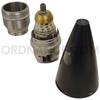
- FUZE MT SQ M577: Identifies the M577 mechanical-time and superquick fuze.
- BWV-7-11 2-78: BWV identifies Bulova Watch Company’s Systems & Instrument Division; 7-11 is the fuze lot marking, and 2-78 indicates February 1978.
M437 Projectile Design and Development
The M437 family was developed for the 175mm M113 and M113A1 cannons carried by the M107 self-propelled gun. Its hollow forged-steel body had a streamlined nose, tapered base, and copper-alloy rotating band. Service projectiles provided blast and fragmentation in support of ground forces. Army data sheets record M437A1 and M437A2 standardization in 1965, distinguishing their original TNT and Composition B fillings. The supplied M437 body marking does not establish either loaded variant.
M577 Fuze and Display Configuration
The M577 is a mechanical-time and superquick fuze, combining clockwork timing with impact functioning. Standardized in 1973, it was intended for projectiles that expelled their payloads in flight. The related M582 incorporated a booster for high-explosive ammunition and is the mechanical-time and superquick model listed in Army data sheets for M437A1 and M437A2 projectiles. The M577 fitted here is as a display configuration, not a standard U.S. service pairing.
M107 Gun Development and Service
The Army accepted its first production M107 in 1962. Developed alongside the M110 8-inch self-propelled howitzer, the M107 shared its tracked chassis while carrying a long-barreled 175mm gun. Its reach of nearly 33 kilometers gave heavy artillery units the ability to support operations across large areas. U.S. artillery units brought M107s into South Vietnam in late 1965, where they served with field-force artillery alongside M110 howitzers. Their common vehicle platform allowed units to change the balance of 175mm guns and 8-inch howitzers as requirements changed.
Transition to the M110 Howitzer Family
During the 1970s, improvements to the M110 introduced a longer-range 8-inch cannon and further ammunition development. The Army’s conversion program reused existing M107 and M110 vehicles, reducing the cost of modernization. Development of the M110A2 and rocket-assisted 8-inch ammunition supported the planned replacement of 175mm guns with improved 8-inch howitzers. This transition places the M437 family within the broader history of American heavy artillery during the Cold War.
Condition
Supplied as an inert M437-series projectile fitted with the marked M577 fuze described above. All ordnance is inert. Please check the pictures for the general condition of the item.
Ideal For
The separate Scranton and Bulova markings provide useful reference points for studying American artillery production.
- M107 self-propelled gun displays and restoration exhibits.
- Cold War heavy artillery ammunition collections.
- Collections documenting Scranton projectile bodies and Bulova fuzes.
- Museum exhibits comparing projectile and fuze identification.
Approx length 38", Approx width 7", Approx height 7", Approx weight 115lbs.
Pictures are stock images of our inventory. Unless otherwise noted, you will not be receiving the exact item shown in the pictures. The pictures are representative of the item’s general condition. The item you receive might be slightly better, or worse, condition than was shown in the pictures.
Please visit our page about order lead times here: Order Lead Times.