




Description
German WWII 15mm High-Explosive Incendiary Tracer Round for the MG 151 Aircraft Gun
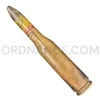
This German 15mm high-explosive incendiary tracer round combines a 1939-dated DWM brass case with an AZ 1552 nose fuze dated 1941. Made for the Mauser MG 151 aircraft gun, this 15×96mm round represents the explosive ammunition carried by Luftwaffe aircraft during World War II. Its surviving yellow paint, red tracer band, and marked components provide useful details for collectors studying German aircraft ammunition and wartime production.
High-Explosive Incendiary Tracer Projectile
The service projectile combined a steel body, copper driving band, nose impact fuze, and tracer at the base. Its explosive and incendiary contents were intended to damage aircraft structure and ignite combustible material, while the tracer helped the gunner observe the flight of the projectile. The surviving yellow body paint agrees with German high-explosive identification markings, and the broad red band above the driving band indicates a red tracer. Small patches of green paint also remain near the nose.
Tracer and Probable Self-Destruct Feature
The main projectile cavity is consistent with the self-destruct version, designated in German service as 15 mm Brandsprenggranatpatrone L’spur m. Zerl. The self-destruct feature was intended to burst the projectile in flight if it missed its target. Period ammunition tables list approximately 1.7 seconds of tracer duration, corresponding to about 1,000 meters, for this loading; that figure describes tracer performance rather than a separately confirmed self-destruct delay.
AZ 1552 Nose Fuze
The fuze carries the markings “AZ 1552,” “wa,” “216,” and “1941.” The manufacturer code wa identifies HASAG, Hugo Schneider AG, lamp manufacturing division. The AZ 1552 was a nose impact fuze used in German 15mm ammunition and was the steel-bodied counterpart of the brass AZ 1551. Its service purpose was to initiate the projectile upon impact. Period references list the AZ 1552 with both self-destruct and non-self-destruct HE incendiary tracer loadings.
DWM Case and Component Markings
The case headstamp reads “DWM 10,” “5e,” and “39,” accompanied by an acceptance mark containing 66. DWM identifies Deutsche Waffen- und Munitionsfabriken, and 39 dates the case to 1939. The bottleneck case has an extractor groove at its base and a primer seated in the head. The projectile also carries a visible 41 date marking. These markings date the individual components.
MG 151 Development and Service Performance
Mauser developed the MG 151 during the 1930s as an aircraft weapon using 15×96mm ammunition. The gun was fully automatic, recoil-operated, and belt-fed, with provisions for fixed or movable aircraft installations. Its ammunition range included explosive incendiary tracer and armor-piercing types for different target effects. The German March 1942 weapon manual lists a 57-gram projectile and 960-meter-per-second muzzle velocity for the 15mm incendiary explosive tracer loading, with a gun firing rate of approximately 700 rounds per minute.
Bf 109 F-2 Application and the 20mm Successor
A documented application was the Messerschmitt Bf 109 F-2, which reached Luftwaffe combat units in early 1941. Its engine-mounted MG 151 fired through the propeller hub and carried 200 rounds, supplementing two 7.92mm MG 17 machine guns above the engine. The preceding Bf 109 F-1 used an MG FF-series 20mm cannon in the central mounting. The later Bf 109 F-4 adopted the 20mm MG 151/20, which retained the basic MG 151 mechanism while accommodating larger explosive projectiles. This places the 15mm round within the rapid development of German fighter armament during the early war years.
Condition
All ordnance is inert. The pictured case has a conspicuous longitudinal split extending from the mouth down the neck toward the shoulder. The projectile shows substantial paint loss, with yellow, red, and green remnants remaining. Tarnish, discoloration, surface wear, and small nicks on the driving band are visible. Please check the pictures for the general condition of the item.
Ideal For
The dated case and marked fuze make this round useful for displays and research focused on German aircraft ammunition production.
- World War II Luftwaffe ammunition collections.
- MG 151 and Bf 109 F-2 armament displays.
- Comparisons of explosive incendiary tracer and armor-piercing aircraft rounds.
- Museum exhibits examining German ammunition markings and component manufacture.
Approx length 6", Approx width 1", Approx height 1", Approx weight 0.6lbs.
Pictures are stock images of our inventory. Unless otherwise noted, you will not be receiving the exact item shown in the pictures. The pictures are representative of the item’s general condition. The item you receive might be slightly better, or worse, condition than was shown in the pictures.
Please visit our page about order lead times here: Order Lead Times.