





Description
U.S. Army 155mm M483A1 Low-Angle Graphical Firing Table Set, FT 155-AK-2
Item Overview
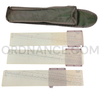
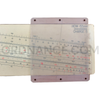
This U.S. Army Graphical Firing Table set is the low-angle manual fire-control calculator for the 155mm M483A1 Dual-Purpose Improved Conventional Munition projectile. Its official designation is Scale, Graphical Firing, HE M483A1, Low Angle. The set contains three double-sided rules, a transparent sliding cursor with a hairline, and the carrying pouch. It was prepared from firing-table data for use with the M109 self-propelled howitzer and M114A2 towed howitzer.
Identification and Features
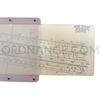
The identifying numbers connect this set to firing table FT 155-AK-2 and the M483A1 projectile. Each rule covers an official pair of propelling charges. Charge 2 was not assigned to a rule in this set and is not a missing component. The rules carry printed scales for range, ballistic elevation, drift, 100/R, fuze information, time of flight, and related firing corrections.
- Official name: Scale, Graphical Firing, HE M483A1, Low Angle
- Firing-table code: FT 155-AK-2
- Set NSN: 1220-01-038-7204
- Set part number: 10556162
- Charges 1 and 3: Rule P/N 11785434-29
- Charges 4 and 5: Rule P/N 11785434-30
- Charges 6 and 7: Rule P/N 11785434-31
- Documented applications: M109 and M114A2 155mm howitzers
- Included equipment: Three double-sided rules, sliding cursor, and carrying pouch
Historical Background
Graphical firing tables were developed to place essential artillery firing-table data on a compact slide-rule instrument. They allowed fire-direction personnel to solve common ballistic calculations faster than working entirely from printed tables. This M483A1 set belongs to the late Cold War period and is based on FT 155-AK-2, dated November 30, 1976. Its federal stock record was established during 1977 as the Army continued to standardize fire-control equipment for newer 155mm ammunition.
Function and Operation
The transparent cursor moved across the printed rule and placed its fine hairline over the required target range. Personnel could then read the corresponding ballistic elevation, projectile drift, 100/R value, fuze-setting or time-of-flight data, and other corrections needed to prepare firing data. The 100/R scale showed the angular change needed to move a burst 100 meters at a given range. This instrument was an artillery ballistic calculator used in the fire-direction center; it was not a gun sight, rangefinder, or propellant-measuring device.
Complete Low-Angle Set Configuration
The three rules form the complete low-angle FT 155-AK-2 set. Their official charge pairings are 1 and 3, 4 and 5, and 6 and 7, which explains why no Charge 2 rule is present. Each rule is double-sided so the required charge data can be selected without adding more pieces to the set. High-angle scales and graphical-site scales were issued separately and were not components of this low-angle set.
M483A1 Projectile Background
The M483A1 was a 155mm cargo projectile developed to deliver 88 dual-purpose submunitions against personnel and lightly armored targets. It was an improved version of the earlier M483 and became an important U.S. artillery projectile during the Cold War. Because its ballistic performance differed from standard high-explosive ammunition, dedicated firing data and matching graphical scales were required. This set gave fire-direction personnel the M483A1 data for the listed charges and howitzer applications.
M109 Self-Propelled Howitzer Application
The M109 entered U.S. service during the early 1960s as a tracked, armored 155mm self-propelled howitzer. It gave field artillery units the mobility needed to move with armored and mechanized forces while carrying its gun crew and ammunition under armor. The design was upgraded through several models and served in training and combat around the world. FT 155-AK-2 documents use of this M483A1 graphical firing table with the M109 weapon system.
M114A2 Towed Howitzer Application
The M114 family began as the 155mm Howitzer M1 during World War II and was later redesignated M114. Weapons in this family served through World War II, Korea, Vietnam, and the Cold War, while later variants received changes intended to extend their service life. The M114A2 was a later towed configuration supported by FT 155-AK-2. When deployed, the howitzer depended on a fire-direction center to convert target information and ballistic data into commands for the gun crew.
History of Use
Graphical firing tables were working tools of the artillery fire-direction center rather than equipment mounted on the howitzer. Fire-direction personnel used them with maps, plotting equipment, weather information, and tabular firing tables to prepare firing commands for the gun sections. Sets of this type served during the transition from fully manual fire-control methods to electronic and digital systems. They remain clear examples of how artillery crews performed complex calculations quickly in field conditions.
Condition
This military-surplus set includes the three officially paired double-sided rules, transparent sliding cursor, and carrying pouch. The absence of a Charge 2 rule is correct for this configuration and does not make the set incomplete. Separate high-angle and graphical-site scales are not part of this low-angle set. The printed firing data, individual rule numbers, and original pouch make this a well-identified example of U.S. artillery fire-control equipment.
Ideal For
This complete set displays the connection between 155mm ammunition, manual ballistic calculation, and the fire-direction process. Its dated firing-table designation and individually numbered rules provide useful details for an accurate artillery collection or interpretive display.
- U.S. field-artillery collections
- M109 and M114A2 howitzer displays
- M483A1 ammunition-history exhibits
- Manual fire-control and fire-direction collections
- Military museums and instructional displays
Approx length 18", Approx width 5", Approx height 1", Approx weight 2.2lbs.
Pictures are stock images of our inventory. Unless otherwise noted, you will not be receiving the exact item shown in the pictures. The pictures are representative of the item’s general condition. The item you receive might be slightly better, or worse, condition than was shown in the pictures.
Please visit our page about order lead times here: Order Lead Times.