




Description
Early U.S. M109 155mm Howitzer Hydraulic Projectile-Rammer Cylinder and Mounting Assembly
Item Overview
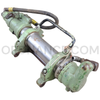
This hydraulic projectile-rammer cylinder and mounting assembly is identified as part of the loading equipment used in an early U.S. Army M109 155mm self-propelled howitzer. The assembly helped seat a projectile in the cannon chamber after the crew manually placed it on the rammer tray. Its cylinder, support brackets, parallel support shaft, and release-handle arrangement closely match the equipment shown in original Army manuals. The visible number 10922827 is recorded as an item marking, but it has not been confirmed as the assembly’s official part number.
Identification and Features
The surviving structure includes the hydraulic rammer cylinder and the hardware used to support, position, and release it during the loading cycle. Army illustrations show the same general arrangement mounted inside the howitzer cab near the breech. The separate loading chute or tray and the broad circular rammer head shown in the manual are not included with this example.
- Application: Early M109 155mm self-propelled howitzer
- Component type: Hydraulic projectile-rammer cylinder and mount
- Visible marking: 10922827
- Included features: Cylinder, support brackets, parallel shaft, and release handle
- Not included: Loading chute or tray and circular rammer head
Historical Background
The M109’s powered rammer was developed to assist with the heavy projectiles used in separate-loading 155mm ammunition. Army TM 9-3305 distinguishes this equipment from the larger loader-and-rammer mechanisms used on systems such as the M107 and M110. On the M109 and M109A1, the crew still lifted and positioned the projectile on the tray by hand, while the hydraulic mechanism supplied the final ramming stroke needed to seat it securely in the cannon.
Function and Operation
To prepare the mechanism, the crew released it from its stowed position and moved it along the rammer support shaft. The cylinder-release handle allowed the cylinder to rotate from the loading position into the ramming position, where a latch held it in alignment with the open breech. When the control circuit and safety switches were engaged, pressurized hydraulic oil entered the cylinder and drove the rammer forward. The rammer seated the projectile against the forcing cone before retracting for the next step in the loading cycle.
End-Item Application
Original M109 manuals place the rammer inside the cab beside the cannon breech and identify a separate rammer valve within the cab hydraulic system. The assembly’s cylinder, brackets, support shaft, and release handle provide a strong physical match to that early installation. Because no exact catalog entry has been located for marking 10922827, the identification is limited to an early M109-type rammer cylinder and mounting assembly rather than a specific verified assembly part number or later M109 variant.
M109 Weapon-System Background
The M109 was accepted by the U.S. Army in the early 1960s as a mobile 155mm artillery system capable of traveling with armored and mechanized forces. The original vehicle used the short M126 or M126A1 155mm howitzer in an M127 mount, carried 28 rounds, and provided full turret traverse. Its tracked chassis, enclosed cab, hydraulic gun controls, and powered rammer combined mobility and crew protection with the striking power of a medium artillery weapon. Later M109 versions received longer cannons, additional ammunition storage, and revised loading equipment.
History of Use
Early M109 howitzers served with U.S. forces during the Vietnam War, where their tracked mobility allowed batteries to move between prepared firing positions and provide 155mm fire support. During a firing mission, the crew opened the breech, selected and prepared the projectile, positioned it on the rammer tray, and used the hydraulic rammer to seat it in the tube. The propelling charge and primer were then loaded separately. This powered assistance reduced the effort required to seat heavy projectiles during repeated firing.
Condition
This is an military-surplus rammer assembly consisting of the hydraulic cylinder, mounting structure, parallel shaft, and associated release-handle hardware. Marking 10922827 remains visible.
Ideal For
This substantial early M109 component is suitable for artillery collections, museum exhibits, vehicle-restoration research, and displays explaining how crews handled separate-loading 155mm ammunition. Its exposed mechanical arrangement also makes it useful for studying the M109’s original hydraulic loading equipment.
- Early M109 restoration research
- Self-propelled artillery displays
- Military hydraulic-system collections
- Museum and educational exhibits
Approx length 23", Approx width 11", Approx height 8", Approx weight 40lbs.
Pictures are stock images of our inventory. Unless otherwise noted, you will not be receiving the exact item shown in the pictures. The pictures are representative of the item’s general condition. The item you receive might be slightly better, or worse, condition than was shown in the pictures.
Please visit our page about order lead times here: Order Lead Times.