






Description
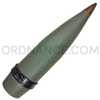
U.S. 155mm M107 High Explosive Howitzer Projectile
This U.S. 155mm M107 howitzer projectile is offered inert for collection and display. The M107 served as a general-purpose high explosive artillery shell across generations of American towed and self-propelled howitzers, making it a useful centerpiece for a U.S. artillery ammunition collection.
Construction and Artillery Role
The M107 design uses a forged-steel body with a streamlined nose, tapered base and rotating band near the rear. The band engaged the barrel’s rifling to impart stabilizing spin. In service, the projectile provided blast and fragmentation effects in support of ground troops. It formed part of a separate-loading ammunition system, with the projectile and propelling charge handled separately. Production included normal and deep fuze-cavity versions to accommodate different service fuzes.
Development and Ammunition Lineage
The M107 was developed for the 155mm M1 howitzer and appears in the Army’s 1944 ammunition manual. That manual describes the related M102 shell for older M1917 and M1918 howitzers as similar, with a narrower rotating band. The M107 continued in service through the Cold War and into the twenty-first century. The later M795 was developed as its replacement, offering improved performance, while the M107 retained an important training role. The M1122 was subsequently introduced to replace the M107 and M804A1 in training while more closely matching the M795’s flight characteristics.
Howitzer Applications and Development
Documented applications include the M1/M114 family, M198 and M777 towed howitzers, along with M109-series self-propelled howitzers. The towed M1 entered production in 1941 and was later redesignated M114, serving through World War II, Korea and Vietnam. The M198 began replacing it in the late 1970s, bringing greater range and improved mobility. The lighter M777 followed as the M198’s replacement beginning in 2005. The self-propelled M109 developed through the experimental T196 and T196E1 program and was standardized in 1963 to provide mobile artillery support for armored formations.
Army and Marine Corps Use
U.S. Army use of the M107 included both combat and live-fire training. Its service also extended to Marine Corps artillery units using modern howitzers. In October 2011, U.S. and Philippine Marines fired M107 ammunition from M777A2 howitzers during joint training at Fort Magsaysay in the Philippines. This documented use shows how a projectile associated with World War II-era artillery remained useful with much later equipment.
Condition
All ordnance is inert. Please check the pictures for the general condition of the item.
Ideal For
The M107 suits collections and exhibits tracing the development of American 155mm artillery ammunition and the weapons that used it.
- U.S. high explosive projectile collections.
- M114, M109, M198 and M777 artillery displays.
- Museum exhibits comparing successive generations of 155mm ammunition.
Approx length 28", Approx width 7", Approx height 7", Approx weight 79lbs.
Pictures are stock images of our inventory. Unless otherwise noted, you will not be receiving the exact item shown in the pictures. The pictures are representative of the item’s general condition. The item you receive might be slightly better, or worse, condition than was shown in the pictures.
Please visit our page about order lead times here: Order Lead Times.