







Description
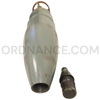
125mm 3OF19 Training Round with Polish V-429E Training Fuze and Z-40 Drill Charge for the D-81 Gun in the T-72 Tank
This inert 125mm tank round pairs a four-fin projectile with a Polish Z-40 drill charge for the Soviet-designed D-81 tank gun. The nose fuze is stamped В-429Е (V-429E) and SZK, identifying it as a Polish instructional example of the V-429E. The separate charge carries the Polish word TRENINGOWY, meaning “training.” Together, the two pieces show the ammunition arrangement familiar to Polish T-72 crews.
Identification & Features
The fuze and charge each carry their own training marks. The projectile body retains several shallow stamps, but none gives a legible model designation.
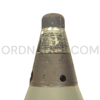
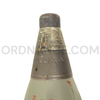
- Nose fuze. The stamped model reads “В-429Е.” English references use V-429E, while Polish military publications use W-429Je. The adjacent “SZK” abbreviates the Polish word szkolny, meaning instructional.
- Fuze maker and date marks. The oval “21” matches the Polish factory code for Zakłady Metalowe MESKO in Skarżysko-Kamienna. The nearby “89” is consistent with a 1989 date for the fuze. The projectile and charge carry separate markings.
- Drill charge. The black charge body is stenciled “TRENINGOWY,” “Z 40,” “125-D81,” and “21OBR-1-90.” These marks identify the training role, charge type, and intended gun.
- Primer. The charge base bears “GUW-7” and “SZKOL.” This is the instructional counterpart of the GUW-7 electric-percussion primer used in Polish 125mm tank ammunition.
- Projectile. Four hinged fins fold against the tail beneath a retaining ring. The body and tail are consistent with the 3OF19 high-explosive fragmentation projectile. The closely related 3OF26 also used four fins and a V-429-series fuze.
The 3OF19 Service Round
The Polish service counterpart is the 3WOF22, also written 3VOF22, with the 3OF19 projectile. It gave tank crews a general-purpose high-explosive fragmentation shell for use against infantry and field positions. The service projectile weighed about 23 kg (51 lb) and used a W-429Je impact fuze in the nose. Its folding fins kept the shell compact in stowage and stabilized it in flight.
Two-Piece Ammunition and Crew Training
The T-72 carried each projectile and its propelling charge separately in a carousel beneath the turret. An automatic loader handled both pieces, allowing the tank to operate with a three-man crew and a low turret. The service Z-40 charge had a combustible body and a short steel base. Its reusable drill counterpart gave crews a full-size charge for loading and unloading practice. The marked instructional fuze also let an instructor identify the nose component separately from the primer in the charge base.
Polish T-72 and PT-91 Service
In 1977, Poland obtained production rights for the T-72M and several rounds for its 125mm 2A46 smoothbore gun, including the 3WOF22. The Pronit plant in Pionki began assembling the licensed ammunition in the early 1980s under the Jaguar program. Poland later retained the 125mm gun on the PT-91 Twardy, and Polish military researchers documented the use of OF-19 ammunition in training for both T-72 and PT-91 crews.
Condition
The four fins and their retaining ring are present. Please check the pictures for the general condition of the item.
Ideal For
The separate components can be displayed side by side, with the fuze markings and charge stencil both visible.
- Polish T-72M and PT-91 tank crew exhibits
- Collections of marked instructional fuzes and drill ammunition
- Museum displays explaining Soviet two-piece tank ammunition
Approx length 42", Approx width 7", Approx height 7", Approx weight 60lbs.
Pictures are stock images of our inventory. Unless otherwise noted, you will not be receiving the exact item shown in the pictures. The pictures are representative of the item’s general condition. The item you receive might be slightly better, or worse, condition than was shown in the pictures.
Please visit our page about order lead times here: Order Lead Times.