





Description
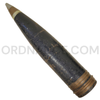
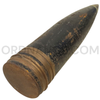
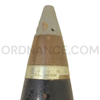
1949 U.S. 120mm T16E1 Chemical Smoke Projectile with M500A1 MTSQ Fuze
Product Overview
This 1949 U.S. 120mm T16E1 projectile represents an early stage in American heavy-tank ammunition development. Identified as “SHELL CHEM,” it belongs to the Army’s white-phosphorus smoke-projectile family. Its date places it in the period of development that preceded the fielding of the M103 heavy tank. The included mechanical-time fuze adds a separate point of interest for collectors studying postwar ordnance.
Identification and Features
The supplied identification describes the following configuration. “CHEM” is the period abbreviation for chemical ammunition, a category that included smoke-producing shells. Army references identify this particular model as a white-phosphorus smoke projectile.
- Date: 1949.
- Designation: SHELL CHEM, 120mm, T16E1.
- Historical role: Smoke production.
- Tracer: Not present.
- Included fuze: M500A1 MTSQ, meaning mechanical time and superquick.
Function
In its original military role, smoke ammunition provided a visible screen or marked a location for other forces. Screening smoke obscured lines of sight and helped conceal movement. White phosphorus produced dense white smoke and also had an incendiary effect. These functions gave smoke projectiles a support role within the tank’s ammunition range, helping crews mark targets and screen activity on the battlefield.
Product History
The T16 series records the development of smoke ammunition for American 120mm tank guns. The Army’s 1967 manual, TM 9-1300-203, Artillery Ammunition, describes the T16E1 as similar to the T16E3 but without the base boss and tracer. A later version, T16E4, became the M357 smoke-tracer projectile, classified as standard in 1961. These separate designations document changes within the family as the Army refined its ammunition range. This example retains the earlier T16E1 identification.
Documented Applications
The later documented weapon application for the T16E1 was the 120mm M58 rifled tank gun used in the M103 heavy-tank family. Its complete ammunition used a projectile and a separate propelling-charge assembly, packed in individual containers. The Army manual describes impact fuzes for this ammunition group. The M500A1 is the fuze fitted to the offered example, but the available references do not establish this specific pairing as an original 1949 factory assembly.
Equipment History
The M500A1 belonged to the M500 series of combination artillery fuzes covered in Army technical and training publications during the 1950s. Its mechanical-time element used clockwork to control when the fuze acted, while a separate impact element provided superquick action. “Superquick” described prompt action on impact. The A1 model revised the timing characteristics of the earlier M500. This design illustrates the precision mechanical engineering developed to control artillery projectile action.
Weapon-System Background
The M103 grew from the T43 heavy-tank project, which began in 1948. The Army wanted a vehicle able to support medium tanks against heavily armored Soviet tanks. The Korean War accelerated development, and production was authorized in 1950 while the design was still being completed. Chrysler built three hundred tanks by the end of 1954. Further changes led to the M103 designation. Its five-man crew included two loaders to handle the large gun’s projectile and propelling-charge components, reflecting the demands of a weapon built around heavy, separated ammunition.
History of Use
The U.S. Army fielded M103 tanks in Europe in 1958, while the Marine Corps became the main operator of the family. Marine improvements included better fire-control equipment and, in the M103A2, a diesel engine. The type remained in Marine service through 1974. Museum records state that the M103 never saw combat, so its history centers on Cold War deployment, training, and readiness. No unit assignment, firing history, or combat provenance has been established for this individual projectile.
Condition
All ordnance is inert. Please check the pictures for the general condition of the item.
Ideal For
This projectile suits a reference collection explaining the development of American tank ammunition. Displayed alongside period manuals and ammunition diagrams, it can help show how model designations, smoke roles, and fuze types were recorded and changed over time.
- U.S. Army ordnance collections.
- Early Cold War ammunition exhibits.
- M103 heavy-tank and M58 gun displays.
- Historical fuze and smoke-projectile reference collections.
Approx length 23", Approx width 5", Approx height 5", Approx weight 41.8lbs.
Pictures are stock images of our inventory. Unless otherwise noted, you will not be receiving the exact item shown in the pictures. The pictures are representative of the item’s general condition. The item you receive might be slightly better, or worse, condition than was shown in the pictures.
Please visit our page about order lead times here: Order Lead Times.