


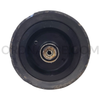

Description
U.S. 120mm T116E5 AP-T Armor-Piercing Tracer Projectile
Product Overview
This U.S. 120mm T116E5 projectile is armor-piercing, tracer shot from the ammunition development family associated with the T43/M103 heavy-tank program. Its designation connects it to the Cold War effort to develop large-caliber ammunition for engaging heavy armor. For collectors, the specific E5 version provides a reference point in the development of American 120mm tank ammunition.
Identification and Features
The Army’s official specification record names this model as “Shot, AP-T, 120-mm, T116E5.” Its designation identifies the ammunition type and version.
- Caliber: 120mm.
- Projectile designation: T116E5.
- AP-T: Armor-piercing, tracer.
- Ordnance classification: Shot.
- Development family: T116-series tank-gun ammunition.
Function
In its original service design, this shot relied on impact energy to penetrate armor. Its tracer provided a visible reference to the projectile’s flight. The Army’s technical listing records the T116E5 without a fuze, consistent with its kinetic armor-piercing role. These features served the tank gun’s direct-fire mission against armored targets.
Product History
The T116 series developed as part of the effort to equip a new American heavy tank during the early Cold War. Progress involved repeated evaluation of the tank, gun, ammunition, and fire-control equipment. Army histories record problems with ammunition flight and gun controls during the broader program’s 1954 tests, followed by corrective development. The T116E5 belongs to this sequence of ammunition versions. The July 1964 Army handbook AMCP 706-247 retained the T116E5 designation in its technical tables, preserving a record of this version within the wider development program.
Documented End-Item Application
The documented application is the 120mm T123 tank-gun program. A 1959 Army maintenance manual identifies the standardized M58 gun as T123E1, establishing the connection between the developmental gun family and the armament used in the M103 heavy tank. This weapon used a rifled barrel and ammunition supplied as a separate projectile and propelling-charge assembly. The projectile offered here represents the shot component of that ammunition system.
Equipment History
Official ammunition records group T116E5, T116E6, T116E7, and M358 within the same AP-T family. The Army’s 1959 cannon manual specifically pairs M358 with T116E7. This documents a later step from a T-series version to a standardized M-series designation. The E5 name identifies the earlier development version represented by this projectile.
Weapon-System Background
The parent heavy-tank project began as the T43 in 1948. Concern about Soviet heavy tanks, including the IS-3 and later T-10, created a demand for a vehicle with greater antitank firepower. The outbreak of the Korean War accelerated the program, and production was authorized before development was complete. Chrysler built three hundred tanks by the end of 1954. The design subsequently became the M103 after further improvement. Its five-man crew included a commander, gunner, driver, and two loaders. The large 120mm gun and its separate ammunition placed heavy demands on the turret crew and influenced the tank’s layout.
History of Use
The U.S. Army fielded M103 heavy tanks in Europe in 1958. The Marine Corps became the principal operator of the tank family, using the improved M103A1 and M103A2 as heavy support vehicles and retaining the type into the 1970s. Marine service continued through 1974. Museum records state that the M103 never saw combat. Its history therefore centers on Cold War deployment, readiness, and the effort to counter heavily armored opponents.
Military Documentation
Army specification MIL-S-13673 covered the assembling, marking, and packing of T116E5 shot. This shows that its designation appeared in a formal supply specification as well as in technical manuals. The Defense Logistics Agency records cancellation of that specification on April 15, 1980, preserving another dated reference in the model’s documentary history.
Condition
All ordnance is inert. Please check the pictures for the general condition of the item.
Ideal For
This projectile suits collections that trace American tank-gun ammunition through its development stages. It also offers a physical companion to T43 and M103 manuals, photographs, and museum displays explaining the final generation of U.S. heavy tanks.
- Cold War U.S. Army and Marine Corps collections.
- T43/M103 heavy-tank exhibits.
- Armor-piercing projectile reference collections.
- Museum displays on American ammunition development.
Approx length 19", Approx width 5.5", Approx height 5.5", Approx weight 50lbs.
Pictures are stock images of our inventory. Unless otherwise noted, you will not be receiving the exact item shown in the pictures. The pictures are representative of the item’s general condition. The item you receive might be slightly better, or worse, condition than was shown in the pictures.
Please visit our page about order lead times here: Order Lead Times.