


Description
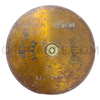
105mm M395 Blank M14B1 Steel Casing for Howitzers, Dated 1953
Item Overview
This 105mm steel casing is associated with the M395 howitzer blank cartridge and carries a 1953 date stamp. Its M14B1 identification connects it to the U.S. steel cartridge-case family. The military charge-weight and lot markings add useful details for collectors of artillery ammunition and early Cold War equipment. Offered as an inert casing, it is suited to a military collection or a display about artillery training and ceremonial gunfire.
Identification and Features
The markings identify the ammunition type, charge weight, and lot. “CHG WT.” means charge weight: the listed 1.70 pounds refers to the original blank charge, not the steel casing’s weight. The lot number served to track a batch of ammunition through military supply channels.
- Caliber: 105mm howitzer ammunition.
- Blank cartridge designation: M395.
- Steel case identification: M14B1.
- Date stamp: 1953.
- Charge-weight marking: CHG WT. 1.70LB.
- Lot marking: SOD 500-2x.
- Listing contents: Inert steel casing.
Function
The complete M395 blank cartridge was designed to produce a loud report, flash, and smoke. It contained a blank charge and primer, with a closure at the case mouth instead of an artillery projectile. The case held these components together for use in a howitzer. This gave military units ammunition for ceremonial gunfire and simulated firing during training. The casing offered here is the collectible component from that ammunition system.
Documented Applications
Army ammunition data sheets list the M395 for the M2A1 and M2A2 cannon used in the M101 and M101A1 howitzer family. They also list the M49 cannon in the M52 and M52A1 self-propelled howitzers, the M103 cannon in the M108, and the M137 cannon in the M102. Later Army procurement records name the M119 alongside the M101, M101A1, and M102. These are documented applications of the M395 cartridge family across both towed and self-propelled artillery systems.
Product History
Army records date the M395’s standard classification to 1962, under Ordnance Technical Committee action OTCM 38091. Standard classification meant the Army had accepted the cartridge as a standard ammunition item. The 1953 stamp on this casing predates that entry and should be read as part of the case’s history; it does not establish when a complete M395 blank was assembled. Later manuals describe both early-production and renovated M395 cartridges, with changes to the way the charge was held inside. The designation remained in use as the cartridge passed through several production periods.
Equipment History
The M14B1 steel case belongs to an ammunition family already documented during World War II. The 1944 U.S. Ordnance catalog lists it as an approved steel alternative for 105mm M1 high-explosive and M67 high-explosive antitank ammunition. Army data sheets describe the M14B1 as drawn steel, distinguishing it from other steel cases made from spiral-wrapped sections. For M395 blanks, the Army lists a separate shortened case family: M15 in brass, M15B1 in steel, and M15B2 in aluminum. The full-length M14B1 service case and shortened M15B1 blank case are distinct designations, a useful detail when comparing case markings with ammunition manuals.
Weapon-System Background
The U.S. 105mm howitzer family grew from development work after World War I. By 1940, the M2A1 design had emerged as a durable, accurate weapon for supporting ground troops. It became a mainstay of American field artillery during World War II and continued in use during the Korean and Vietnam Wars. The weapon later received the M101 designation. Its ammunition range included high-explosive, smoke, and other specialized rounds. The lighter M102 entered production in 1964 and offered easier movement by helicopter. The M119 entered U.S. service in 1989, continuing the role of 105mm artillery in light units.
History of Use
The M395’s service history centers on training and military ceremonies. Army procurement records describe its use for field exercises, retreat ceremonies, salutes for visiting dignitaries, and military burials. Those records also identify a reserve requirement for ceremonies following the death of a former president. In training, blank ammunition supplied the sound of artillery fire for an exercise. In ceremonial service, it supplied the gun reports used to mark honors and formal events. The M395 was a noncombat cartridge, even though the howitzers that fired it also served on the battlefield. The markings on this casing do not identify a particular unit or event.
Ideal For
This dated steel casing suits collections that explore the support roles of artillery, including training, military honors, and ammunition supply. Its case identification, charge-weight marking, and lot number make it useful for comparing military marking styles and explaining the difference between a cartridge case and a complete round.
- U.S. artillery ammunition collections
- Early Cold War military displays
- Howitzer history exhibits
- Ceremonial salute displays
- Cartridge-case and marking studies
Approx length 6", Approx width 5", Approx height 5", Approx weight 3.9lbs.
Pictures are stock images of our inventory. Unless otherwise noted, you will not be receiving the exact item shown in the pictures. The pictures are representative of the item’s general condition. The item you receive might be slightly better, or worse, condition than was shown in the pictures.
Please visit our page about order lead times here: Order Lead Times.