






Description
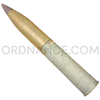
105mm M14 Drill Round with Dummy M59 Fuze and Increment Charge Bags
Product Overview
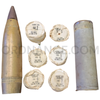
The 105mm M14 drill round is a U.S. military training assembly for howitzer crews. This inert example includes a steel drill cartridge case with a brass rim, an empty M14 drill projectile, a dummy M59 nose fuze, and six dummy increment charge bags. Together, these components show the form of semifixed artillery ammunition, which has a projectile and cartridge case that can be separated.
Identification and Features
The case and projectile carry separate ammunition lot markings. Those numbers identify their respective lots and should be recorded separately when documenting the assembly. The numbered dummy bags identify the increments supplied with this example. Army reference codes below apply to the M14 model.
- Caliber: 105mm
- Model: M14 drill round
- Drill cartridge case: steel with brass rim
- Case marking: WOC-7-42
- Case ammunition lot: AMM LOT 37-23144-3
- Projectile: empty M14 drill projectile
- Projectile ammunition lot: AMM LOT NO. 37-23144-7
- Fuze: dummy M59, identified as SQ
- Dummy increment bags included: Nos. 1, 2, 4, 5, 6, and 7
- Army model references: DODAC 1315-C458; drawing 72-3-78
Function and Contents
The M14 was designed for ammunition handling and loading practice. Its dummy bags represented the separate sections of a service propelling charge without containing live propellant. Military manuals describe the standard dummy charge as seven sections: one base section and six additional increments. The M59 reproduced a service nose fuze for training. SQ means superquick, a term for prompt impact action in service fuzes. On this assembly, the M59 is an inert dummy component.
Documented Applications
World War II Army references list the M14 drill cartridge for the 105mm M2, M2A1, M3, and M4 howitzers. The M2 and M2A1 served field artillery units, while the shorter M3 served airborne forces. The M4 was the howitzer fitted to 105mm Sherman tanks. Later Army data list the M101 and M101A1, the M102 with its M137 cannon, and the M52, M52A1, and M108 self-propelled howitzers. These are documented applications of the M14 model across towed and vehicle-mounted weapons.
Product History
The M14 was documented in the Army's 1944 Artillery Ammunition manual as a semifixed drill cartridge with a dummy M59 fuze. Its design followed the separate case, projectile, and bagged-charge layout that crews encountered in service ammunition. The model remained in later Army references, including the 1994 Army Ammunition Data Sheets. This long record connects its World War II origins with decades of postwar training. The component markings on this example add specific lot information to that broader model history.
Equipment History
Army descriptions show how the M14 was built for repeated drill use. The 1944 manual describes a steel tube case and a hollow bronze projectile. The projectile's open base helped with removal during training. Later data also describe malleable-iron projectile versions, showing that the same model could use different materials. The M59 belonged to a wider group of training fuzes. Army maintenance tables identify it as a dummy substitute for M48, M51, M557, and M572 series point-detonating fuzes.
Weapon-System Background
The U.S. Army's 105mm light howitzer family traces its history to 1928. M2A1 production began in 1940, and it became the Army's main field artillery weapon during World War II. Rock Island Arsenal made its carriage and recoil mechanism. Later known as the M101, the weapon continued in American service during Korea and Vietnam. Howitzers supported troops by firing shells in an arc, often at targets beyond the crew's direct view. Their ammunition included high-explosive and smoke rounds. The lighter M102 entered production in 1964 and helped meet the need for artillery that helicopters could move through difficult terrain.
History of Use
Drill ammunition was part of the Army's system for turning individual soldiers into coordinated gun crews. The 1952 FM 6-75 manual called for repeated practice and set training standards using drill rounds by day and night. It also directed crews to rotate duties so each member could learn other positions. Officers supervised training, while section chiefs kept individual progress records. These records describe the training setting for equipment such as the M14. The aim was a crew that could work quickly and accurately under the stress of combat.
Condition
This assembly is offered as inert drill equipment with an empty projectile and dummy training components. Six numbered dummy bags are included. Bag No. 3 is not included, so the supplied group is a partial set of the standard seven-section dummy charge.
Ideal For
This M14 assembly suits collections and exhibits that explain military training as well as artillery equipment. The metal components and numbered dummy bags allow a display to identify the main parts of a semifixed round. Its separate case and projectile lot markings also make it useful for a collection focused on ordnance identification and military supply records.
- U.S. artillery and militaria collections
- World War II and Cold War training displays
- M2A1, M101, and M102 howitzer exhibits
- Military museums and history classrooms
- Studies of ammunition markings and drill equipment
Approx length 31", Approx width 5", Approx height 5", Approx weight 46lbs.
Pictures are stock images of our inventory. Unless otherwise noted, you will not be receiving the exact item shown in the pictures. The pictures are representative of the item’s general condition. The item you receive might be slightly better, or worse, condition than was shown in the pictures.
Please visit our page about order lead times here: Order Lead Times.