




Description
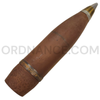
105mm M1 HE Projectile with M501A1 Nose Fuze
This 105mm M1 HE projectile with M501A1 nose fuze is an inert U.S. artillery collectible. The M1 was a standard high-explosive shell in the American 105mm howitzer ammunition family. Its stamped factory code adds a useful identification detail for collectors who study military ammunition production.
Product Identification and Features
The factory stamp identifies the projectile body separately from the nose fuze. In U.S. military manufacturer records, NPK is the symbol for National Presto Industries, Inc., of Eau Claire, Wisconsin. The full marking is preserved below without changing its number sequence.
- Caliber: 105mm.
- Projectile model: M1 high explosive, commonly shortened to HE.
- Included nose fuze: M501A1 Mechanical Time and Superquick, or MTSQ.
- Marking above the driving band: "NPK-1-1965-1978 105 MM HE M1".
Function and Construction
In military service, the M1 shell produced blast and fragments to support ground troops. Its body was forged from steel and shaped with a long, curved nose and a tapered, boat-tail base. A copper-alloy driving band engaged the grooves inside the howitzer barrel, giving the shell spin for stable flight. A welded base cover helped protect the interior from hot propellant gases. Service versions carried TNT or Composition B, depending on the ammunition variant. These details describe the original service design.
Product History
The M1 projectile was already established during World War II. The Army's 1944 ammunition manual describes it with M48-series impact fuzes and the M54 time-and-superquick fuze. Later manuals retained the M1 while documenting newer fuze options and additional howitzer models. This long service life makes the M1 a useful example of a shell design that continued through several generations of artillery equipment.
Documented Applications
Wartime records list M1 HE ammunition for the M2, M2A1, M3, and M4 105mm howitzers. Later Army data sheets document the M101 and M101A1 towed howitzers, the lightweight M102, and the M52, M52A1, and M108 self-propelled howitzers. These records establish the projectile family's broad use across towed and vehicle-mounted artillery. The installed M501A1 is described here as part of the supplied collectible assembly.
Equipment History
The American 105mm light-howitzer program grew from recommendations made after World War I. An early M1 howitzer was standardized in 1928, followed by the M2 and M2A1 designs. The M2A1 entered production in 1940 and became a mainstay of U.S. field artillery during World War II. The weapon family later received the M101 designation. In the 1960s, the lighter M102 added a carriage suited to transport by helicopter, helping artillery units move into positions that were difficult to reach by road.
Weapon-System Background
The M1 belonged to a semifixed ammunition system. In this system, the projectile and cartridge case formed a complete round, but the projectile could be separated from the case. Bagged propellant increments allowed different service charges for different ranges. The M101A1 combined a rifled cannon with a wheeled, split-trail carriage and a recoil system that absorbed firing shock. Its sights supported direct fire at visible targets and indirect fire at targets beyond the crew's view. The ammunition, gun, sights, and trained crew worked together as one artillery system.
M501A1 Fuze History
The M501A1 combined mechanical timing with superquick impact action. Its service time scale ran from 2 to 75 seconds, and its design used an aluminum head and body with a brass lower cap. By 1961, Army training publications described the M501 family as part of the replacement for older time fuzes. Army projectile-and-fuze tables document M501-series use with M84 smoke and M314 illumination shells. This history explains the supplied fuze's role within the wider 105mm ammunition family.
History of Use
American 105mm howitzers supported troops during World War II, the Korean War, and the Vietnam War. High-explosive ammunition served in infantry support, defensive fire, and attacks on field positions. During Vietnam, both the older M101 family and the lighter M102 helped provide artillery support from established bases and remote positions. The M1 shell remained documented in Army ammunition references well beyond its wartime beginnings. A specific unit assignment or combat history for this individual projectile has not been established.
Ideal For
This projectile suits collections that trace the development of U.S. field artillery ammunition. Its factory marking supports maker-code study, while the supplied fuze adds an example of mechanical time-fuze design. It can also anchor a display explaining the separate roles of projectile bodies, fuzes, and howitzer equipment.
- U.S. artillery and ammunition collections.
- M101 and M102 howitzer history displays.
- Museum exhibits on military manufacturing.
- Educational study of external projectile and fuze features.
Approx length 20", Approx width 5", Approx height 5", Approx weight 27.5lbs.
Pictures are stock images of our inventory. Unless otherwise noted, you will not be receiving the exact item shown in the pictures. The pictures are representative of the item’s general condition. The item you receive might be slightly better, or worse, condition than was shown in the pictures.
Please visit our page about order lead times here: Order Lead Times.