




Description
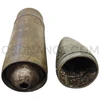
German WWII 105mm 10 cm Gr. 39 rot Hl/C Hollow-Charge HEAT Projectile with A.Z. 38 Fuze
Retaining its original yellow paint and red stripe above the driving band, this German 105mm 10 cm Gr. 39 rot Hl/C projectile is fitted with an A.Z. 38 impact fuze dated 1943. The Hl/C was a later development of Germany’s wartime hollow-charge ammunition for the 10.5 cm leFH 18 howitzer family. Its original finish, body markings, and marked fuze give collectors a useful example for studying German artillery ammunition and wartime identification practices.
Identification and Features
The Gr. 39 rot Hl/C design used a steel projectile body with a separate light-metal nose section carrying the fuze. The abbreviation Hl refers to Hohlladung, or hollow charge. The word rot means red and corresponds to the red stripe above the driving band. Although the projectile’s caliber is 105mm, contemporary ammunition references retain the designation 10 cm Gr. 39 rot Hl/C.
- Body marking “91”: German filling code for cyclonite, also known as RDX, with wax. This identifies the historical service filling.
- Additional body marking: “12 A,” preserved here without an unverified interpretation.
- Acceptance marking: Eagle inspection stamp with a small maker code.
- White base lettering: “II” and a partial inscription reported as “…Gr. 36x.” The incomplete lettering is not used to assign a different projectile model.
Hollow-Charge Development and Role
The Gr. 39 hollow-charge family progressed from the original Hl design through the Hl/A, Hl/B, and Hl/C. These versions introduced changes to the nose section, explosive filling, and internal charge arrangement. The British wartime Handbook of Enemy Ammunition identified the Hl/C as the standard issue version when its comparison of the three later designs was published. Hollow-charge ammunition gave field howitzers an antitank capability by concentrating explosive energy against armor. This allowed relatively low-velocity artillery to engage armored targets without depending on the high striking speed required by conventional armor-piercing shot.
A.Z. 38 Impact Fuze
The fuze is marked “A.Z. 38 ckh 43 105.” A.Z. stands for Aufschlagzünder, identifying an impact fuze. The A.Z. 38 was used with German hollow-charge projectiles and provided instantaneous impact action without an adjustable delay. Contemporary references describe the standard model with an aluminum body. The marking “ckh” is the maker code, while “43” dates the fuze to 1943.
Field Howitzer Application and History
The Hl/C projectile is documented for the 10.5 cm leFH 18 and leFH 18M, weapons that formed a major part of German divisional field artillery during World War II. Rheinmetall began developing the leFH 18 in 1928, and the German Army formally adopted it in 1935. These howitzers supported infantry against troops, gun positions, and field fortifications, with hollow-charge ammunition adding an option against armor. Production of the leFH 18M began in 1940; its muzzle brake and revised recoil system supported increased range. The later leFH 18/40 combined the ballistic performance of the 18M with a lighter carriage derived from the 7.5 cm Pak 40 to improve mobility.
StuH 42 Assault Howitzer Connection
German ammunition allocation tables dated May 1, 1944, also list 10 cm Gr. Patr. 39 rot Hl/C StuH 42 ammunition for the 10.5 cm Sturmhaubitze 42. This armored assault howitzer mounted a weapon derived from the leFH 18M on a Panzer III chassis, with electrical firing adapted to the vehicle installation. Its ammunition included high-explosive and hollow-charge types. This provides a documented connection between the Hl/C projectile family and German assault artillery, although it does not establish that this particular projectile came from a StuH 42 unit.
Condition
The projectile retains its original yellow paint with a red stripe above the driving band and includes the marked A.Z. 38 fuze described above. All ordnance is inert. Please check the pictures for the general condition of the item.
Ideal For
This projectile offers specific display and research value for collections focused on German artillery ammunition and preserved wartime finishes.
- WWII German artillery and hollow-charge ammunition collections.
- Displays interpreting the leFH 18 family and StuH 42 ammunition.
- Study of original paint, filling codes, acceptance stamps, and fuze markings.
Approx length 20", Approx width 4", Approx height 4", Approx weight 23.3lbs.
Pictures are stock images of our inventory. Unless otherwise noted, you will not be receiving the exact item shown in the pictures. The pictures are representative of the item’s general condition. The item you receive might be slightly better, or worse, condition than was shown in the pictures.
Please visit our page about order lead times here: Order Lead Times.